
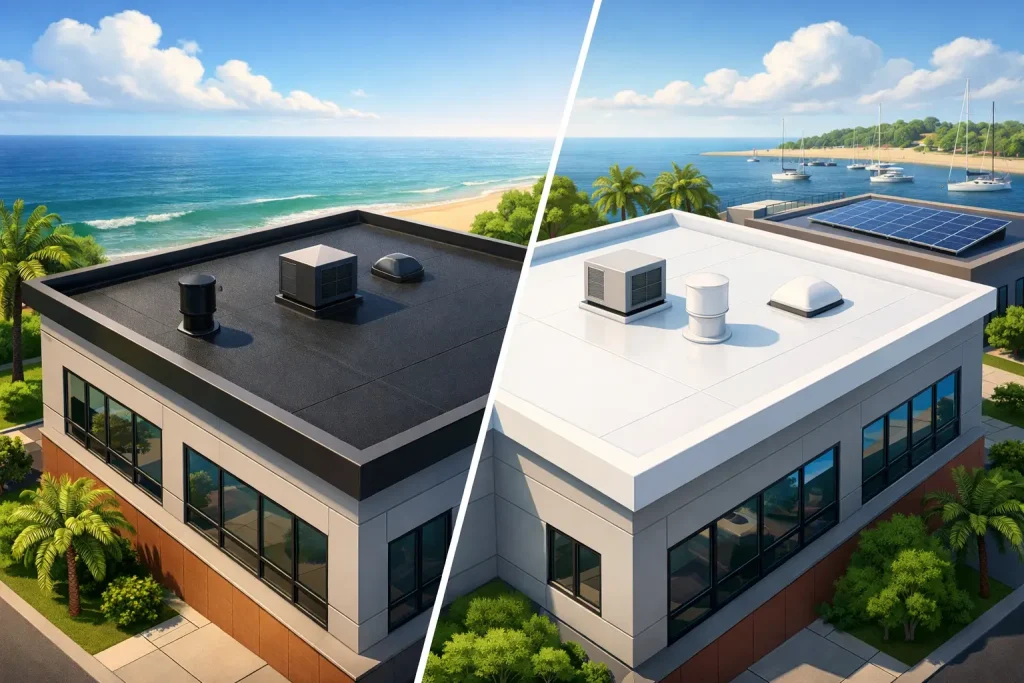
A flat roof can look fine from the ground while water works its way into insulation, decking, and occupied spaces. For South Mississippi property owners, the EPDM versus TPO roofing decision is not just about material price. It affects how the roof handles punishing sun, heavy rain, standing water, wind-driven storms, repairs, and long-term operating costs.
Both systems can protect a commercial building well when they are properly specified and installed. Neither is automatically the right answer for every hotel, retail center, apartment complex, warehouse, office, or low-slope residential roof. The best choice starts with the roof’s condition, drainage, building use, budget, and the kind of maintenance the owner is prepared to perform.
EPDM Versus TPO Roofing: The Basic Difference
EPDM is a synthetic rubber roofing membrane. It is usually black, although white-coated options and reflective coating systems are available. It has been used on commercial low-slope roofs for decades and is known for flexibility, dependable weather resistance, and straightforward repair options.
TPO is a single-ply thermoplastic membrane, most commonly white or light-colored. Its seams are heat-welded instead of glued or taped. That welded seam is one of TPO’s biggest selling points, particularly on wide open commercial roofs where seam strength and water resistance matter.
Both membranes are installed over an approved substrate and insulation system. They may be mechanically attached, fully adhered, or ballasted in certain applications. The membrane itself is only one part of the roof assembly. Drainage, flashing details, penetrations, edge metal, insulation, and installation quality have just as much to do with whether a roof stays dry.
When EPDM Makes Sense
EPDM remains a practical choice for many property owners because it is proven, flexible, and often cost-effective. The material handles temperature movement well. That matters on roofs with a lot of expansion and contraction, as well as buildings with irregular shapes, older decks, or numerous penetrations.
A black EPDM membrane absorbs heat. On a cooler-weather building, that can be an advantage. Along the Gulf Coast, however, that heat gain usually needs to be considered carefully. A dark roof can raise roof-surface temperatures and put more demand on air conditioning. A reflective roof coating may help reduce that heat load while extending the service life of an existing EPDM roof, assuming the membrane is dry, secure, and still a good candidate for restoration.
EPDM repairs are often manageable when damage is caught early. A trained roofing crew can patch punctures, restore flashing, and address failed seams or transitions. That does not mean EPDM is maintenance-free. Branches, dropped tools, rooftop traffic, clogged drains, and storm debris can damage any low-slope system.
EPDM may be a strong fit when the project needs a dependable membrane at a controlled upfront cost, the roof has complicated details, or the owner is considering a restoration coating plan rather than immediate replacement.
Where TPO Has an Edge
TPO is popular across the Gulf Coast for a clear reason: its white surface reflects a significant amount of sunlight. That can help keep the roof surface cooler and may reduce cooling demand in buildings that run air conditioning for much of the year. For restaurants, retail spaces, offices, schools, and occupied multifamily buildings, that energy factor can be meaningful.
Heat-welded seams are another major advantage. Properly welded laps create a continuous bond that is highly resistant to water entry. This is especially valuable during long, hard rain events, when weak seams and poorly detailed penetrations tend to reveal themselves quickly.
TPO also performs well on large, open roofs where a bright, clean appearance and strong seam performance are priorities. It is commonly installed in wide sheets, which can reduce the number of seams compared with some other assemblies.
Still, TPO is not a shortcut. Welds must be completed with the right equipment, temperature, speed, and pressure. Flashing at drains, curbs, parapet walls, and HVAC penetrations must be detailed correctly. A low bid that cuts corners on insulation, drainage correction, edge metal, or installation labor can turn a good material into a leaking roof.
Cost Is More Than the Installed Price
Property owners often ask which system costs less. The honest answer is that it depends on the roof. EPDM can sometimes offer a lower material and installation cost, particularly on certain roof layouts. TPO can carry a higher initial cost in some cases, but its reflective surface may improve energy performance and its welded seams can be a strong long-term benefit.
The bigger cost question is lifecycle value. A roof with poor drainage, saturated insulation, deteriorated decking, or extensive storm damage needs more than a new membrane. Skipping necessary tear-off, insulation replacement, tapered insulation, or flashing work may reduce the invoice today but create expensive repairs later.
A useful estimate should separate the important parts of the job: removal or preparation, insulation, membrane thickness, attachment method, flashing, drainage work, edge details, warranty options, and any required deck repair. That lets owners compare proposals fairly instead of comparing one bottom-line number against another.
Gulf Coast Weather Changes the Conversation
In Biloxi and throughout South Mississippi, a low-slope roof has to stand up to more than routine rainfall. It may face intense UV exposure, humid conditions, hurricane-season winds, debris impact, and repeated heavy downpours. The right roof system should be selected with those local conditions in mind.
TPO’s reflective surface is often appealing in this climate, especially for air-conditioned commercial buildings. EPDM’s flexibility and repairability can also be valuable, particularly on roofs with unusual details or an existing membrane that may be restored with a quality coating system.
Wind resistance is not determined by membrane type alone. It comes from the full assembly – deck condition, fastener pattern, adhesive coverage, perimeter attachment, edge metal, and flashing details. For buildings exposed to coastal storms, those details deserve serious attention. A membrane with a strong manufacturer warranty is helpful, but proper installation is what gives the system a real chance to perform when the weather turns.
Repairs, Coatings, and Replacement Decisions
A leak does not always mean a full replacement is necessary. If the membrane is structurally sound and the insulation is dry, repairs and a roof coating system may provide years of additional service at a lower cost than tear-off. This can be an especially smart option for aging EPDM roofs with widespread surface wear but no major underlying failure.
TPO roofs can also be repaired, but the repair area must be properly cleaned and prepared so the new patch can be welded correctly. On either system, recurring leaks around drains, pipe boots, wall flashing, or HVAC curbs may point to detail failures rather than a complete membrane failure.
Replacement is usually the better path when there is widespread wet insulation, extensive seam failure, brittle or deteriorated membrane, major ponding water problems, or repeated leaks in multiple areas. An inspection should identify the source of the problem before anyone recommends a one-size-fits-all solution.
How to Choose Between EPDM and TPO
Start with the building, not the product name. A warehouse with limited cooling needs and a complicated roof layout may have different priorities than a hotel or shopping center with high energy use and a large, visible white roof. The age of the existing roof, roof deck condition, drainage, budget, and future plans for the property all matter.
Choose TPO when reflective performance, heat-welded seams, and a bright roof surface are top priorities. Choose EPDM when proven rubber performance, flexibility, and repair options fit the roof and budget better. If the existing roof is a candidate for restoration, a professionally applied coating system may be the most affordable solution of all.
The right contractor should inspect the entire roof system, explain the trade-offs in plain language, and provide a written scope that matches the building’s real needs. Expert Roofing helps Gulf Coast owners evaluate repairs, coatings, and replacement options with free estimates, dependable workmanship, and practical recommendations. Before another storm exposes a small roof issue, have the roof checked and make a plan that protects the property for the long haul.