
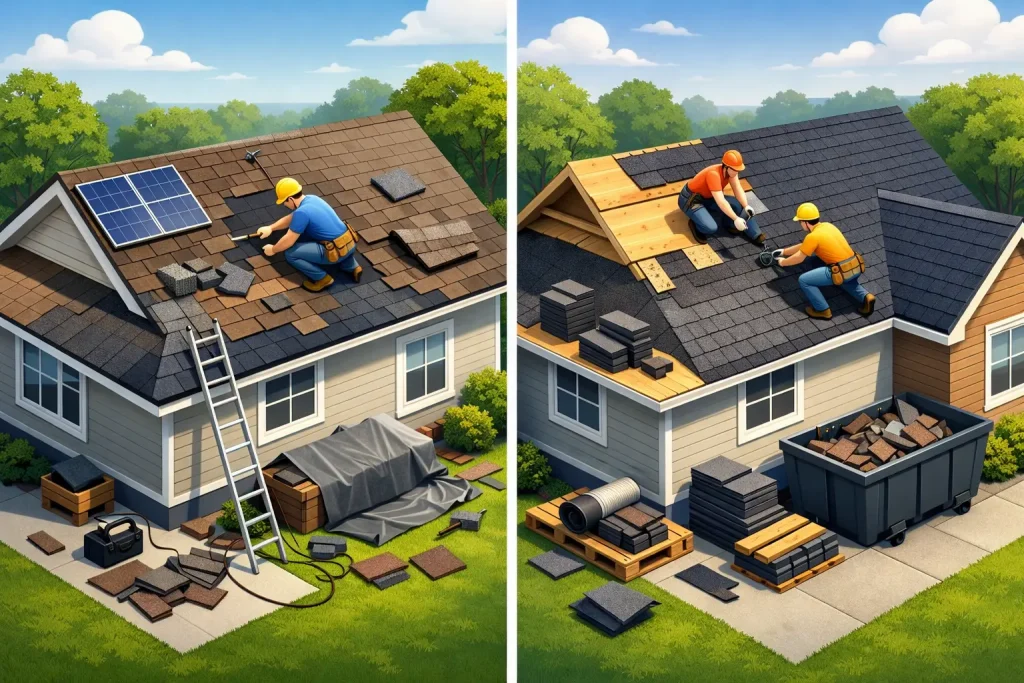
A small leak after a hard Gulf Coast storm can turn into a big decision fast. When homeowners and property managers start weighing roof repair vs reroofing, the real question is not just cost – it is whether you are fixing a short-term problem or solving the roof issue for good.
That choice matters more in South Mississippi than it does in milder climates. Between wind-driven rain, heat, humidity, and storm season, a roof that looks “mostly fine” can still be hiding wet decking, failing flashing, or widespread wear. The smartest move is the one that fits the roof’s actual condition, not just the cheapest number on paper.
Roof repair vs reroofing: what is the difference?
Roof repair means addressing specific trouble spots without replacing the entire roof system. That might include replacing missing shingles, sealing penetrations, repairing flashing, fixing a leak around a vent, or patching damaged sections after wind or debris impact. Repairs are targeted, faster, and usually less expensive up front.
Reroofing is broader. In many cases, people use the word to mean replacing the roof covering across the whole roof, whether that is shingles, metal panels, or a flat roofing system. Sometimes reroofing can refer to installing a new layer over an existing roof where code and roof condition allow, but often the right approach is a full tear-off and replacement so underlying damage can be inspected and corrected.
The key difference is scope. Repair handles isolated problems. Reroofing addresses system-wide age, wear, or failure.
When roof repair is the smarter move
A repair makes sense when the problem is limited and the rest of the roof still has solid life left in it. If a storm peeled off a few shingles, flashing lifted around a chimney, or one section is leaking because of a failed boot or seam, a focused repair can be the right financial decision.
This is especially true on newer roofs. If your roof is relatively young, installed correctly, and the damage is confined to one area, replacing the entire thing is often unnecessary. A good repair can restore performance and buy you years of service.
Repairs also make sense when you need to act fast. Emergency tarping, leak control, and immediate storm damage work can protect the interior and stop the problem from spreading while you sort out insurance, budgets, or next steps.
That said, repair only works well when the surrounding roof is still dependable. Fixing one spot on a roof that is failing everywhere else usually becomes a cycle of repeat service calls.
Signs a repair may be enough
If the roof has localized damage, limited water intrusion, and no widespread sagging or material breakdown, repair is worth serious consideration. The same goes for isolated flashing issues, a small number of missing shingles, or punctures on a commercial roof caused by foot traffic or debris.
For flat and low-slope roofs, a repair can also be effective when seam separation, minor ponding damage, or isolated membrane wear has not spread across the full system. In some cases, restoration coatings can extend life without a full replacement, which is one reason property owners look for contractors who understand both traditional roofing and coating-based solutions.
When reroofing is the better investment
If the roof is old, leaking in multiple areas, or showing broad material failure, reroofing usually makes more sense than pouring money into repeated repairs. A roof near the end of its expected lifespan is not a good place to keep patching.
For shingle roofs, warning signs include widespread granule loss, curling or brittle shingles, soft spots in the decking, recurring leaks, and visible aging across large sections. For metal roofs, recurring fastener issues, corrosion, panel movement, and failing seams can point to a bigger system problem. For commercial roofs, extensive blistering, ponding, membrane breakdown, or repeated leak history often means the roof needs more than spot work.
There is also the issue of hidden damage. Once water gets under roofing materials, it can affect decking, insulation, fasteners, and structural components. A reroof gives the contractor a chance to expose what is happening underneath and fix it correctly. That is hard to do with patch-only work.
In many cases, reroofing costs more now but saves more later. You are not paying for the same leak to be chased around the building every storm season.
Cost is important, but value matters more
Most people start with price, and that is understandable. Repair is usually the lower-cost option up front. Reroofing is a larger investment. But the better question is cost over time.
A $900 repair that solves the problem for five years is money well spent. A $900 repair that leads to another $1,200 repair, then interior damage, then mold concerns, then a full replacement anyway is a different story.
That is why honest inspection matters. A dependable contractor should be able to tell you when a repair is practical and when it is just delaying the inevitable. If you are being pushed straight into full replacement without a clear explanation, that is a red flag. If you are being promised that a heavily worn roof can be patched forever, that is another one.
For many South Mississippi property owners, financing can also change the conversation. A reroof may be the stronger long-term option if affordable payment options keep it within reach now.
Roof age changes the answer
Age does not decide everything, but it strongly influences whether roof repair vs reroofing is the right path.
If a roof is early in its life and has a single issue, repair is often the right call. If the roof is getting close to the end of its expected service life, even a clean-looking repair may only be a temporary fix. Matching older shingles can be difficult, brittle materials may crack during repair, and nearby sections may fail soon after the first issue is corrected.
That does not mean every older roof needs immediate replacement. It does mean repair decisions should be made with realistic expectations. On an aging roof, a repair may be best viewed as a short-term measure while you plan for reroofing.
Storm damage can blur the line
On the Gulf Coast, storms complicate everything. Wind can damage one slope and leave another looking untouched. Hail can bruise shingles without obvious leaks for months. Heavy rain can expose weak points that have been there for years.
That is why post-storm roof decisions should be based on inspection, not assumptions. A roof with scattered visible damage may still be repairable. A roof with lifted edges, compromised underlayment, or water intrusion in multiple sections may be a better candidate for reroofing.
Insurance may also affect the scope, but the roof condition should drive the recommendation. The goal is not to do the biggest job possible. The goal is to restore dependable protection and avoid repeat failures.
Commercial roofs need a lifecycle approach
For commercial property owners, reroofing decisions are often less about one leak and more about asset management. A retail center, hotel, school, warehouse, or apartment complex cannot afford chronic water intrusion, interior disruption, or emergency shutdowns.
In that setting, repair may be the right move if the roof system is still fundamentally sound and the issue is isolated. But if leaks are recurring, the membrane is aging out, or waterproofing is breaking down over wide areas, reroofing or restoration often delivers better lifecycle value.
This is where coatings can become part of the conversation. Not every commercial roof needs a full tear-off. If the substrate is still in decent shape, a roof coating or restoration system may bridge the gap between simple repair and full replacement. That option depends on roof type, moisture condition, and overall wear, but it can be a practical answer for many flat and low-slope buildings.
How to choose the right contractor for the call
This decision is only as good as the inspection behind it. You want a contractor who can handle repairs, replacements, and restoration options – not someone locked into selling only one type of solution.
Look for plain answers. Ask what is damaged, how widespread it is, whether the decking is affected, how much life is realistically left, and what happens if you repair instead of reroof. A solid contractor should explain the trade-offs clearly, provide a written scope, and give you a recommendation that matches the roof, not just the sales goal.
For homeowners and commercial clients in Biloxi and across South Mississippi, that local experience matters. Roofs here deal with conditions that punish shortcuts. Expert Roofing works with property owners who need direct advice, fair pricing, free estimates, financing options, and real solutions – whether that means a straightforward repair, a full reroof, or a coating-based restoration plan.
If your roof is leaking, aging, or showing storm damage, do not wait until the next heavy rain makes the decision for you. The right fix is the one that protects your property, fits your budget, and holds up when the weather turns rough again.