
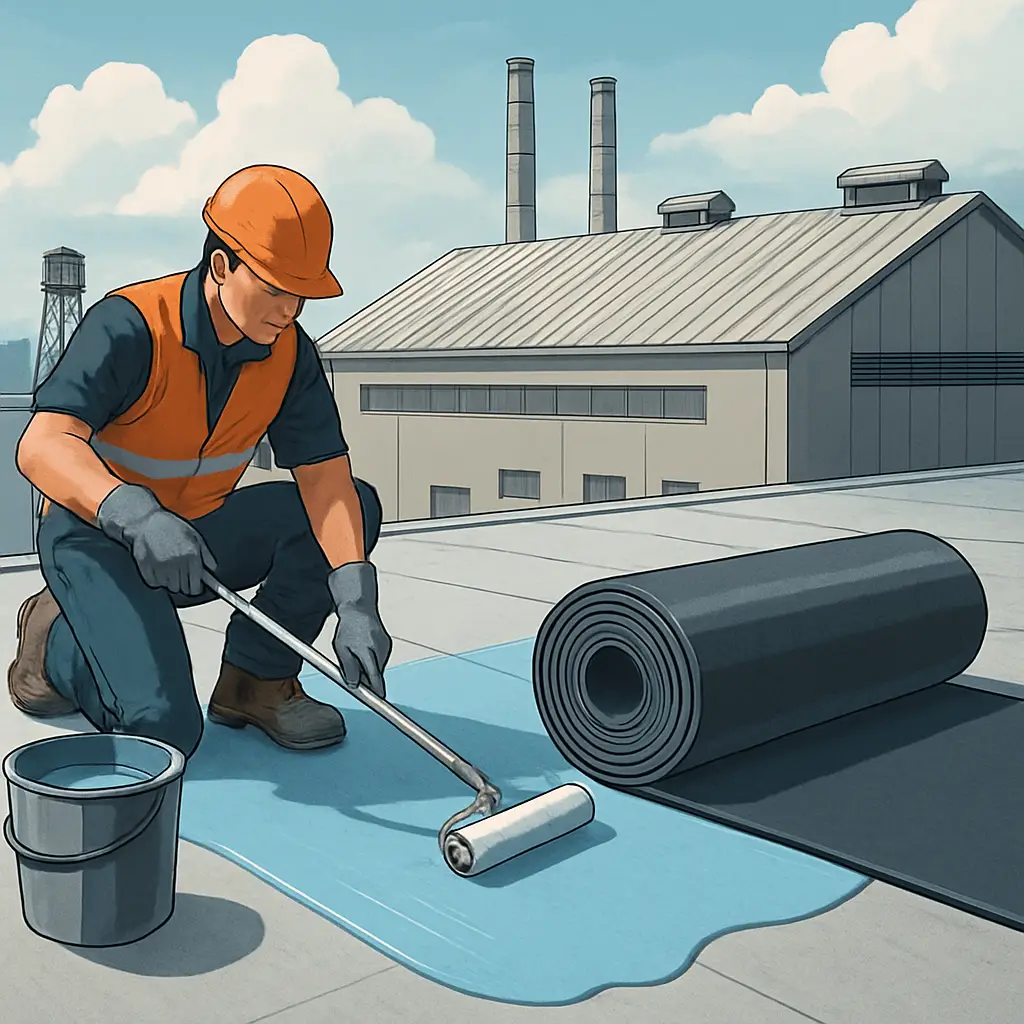
Industrial Roof Waterproofing Options: Coatings, Membranes and Long-Term Maintenance Plans
If you manage an industrial roof, waterproofing is not an aesthetic upgrade — it is risk management for operations, inventory, and asset value. This guide cuts through coating chemistries, single-ply and thermoplastic membranes, and metal-roof repair options so you can weigh cost, downtime, warranty trade-offs, and realistic service life. You will get a practical decision framework, inspection and recoat schedules, and the RFP and cost details needed to choose the right solution for low-slope and metal industrial roofs.
Industrial Roof Risk and Why Waterproofing Strategy Matters
Immediate business risk: water on an industrial roof is rarely a cosmetic problem – it threatens production continuity, inventory, structural members, and insurance eligibility. FM Global and the NRCA repeatedly find deferred maintenance and ponding water are leading causes of commercial roof losses, so waterproofing is a risk-management decision as much as a capital one. FM Global NRCA Technical
Failure modes that actually cost you money: seam separation, fastener corrosion on commercial metal roofs, membrane punctures around rooftop equipment, flashing breakdown, and insulation saturation under flat roof systems. Each failure mode has a different timeline – some cause sudden, visible leaks; others silently reduce thermal performance or corrode structure until a catastrophic failure occurs.
Why strategy changes with risk profile
Strategic consideration: choose a waterproofing approach based on what failure would cost, not just installed price. If a leak shuts a production line for a day, a higher upfront investment in a welded PVC or mechanically fastened TPO with rigorous seam QA is justified. If the roof covers low-value storage and downtime is acceptable, a coating restoration may give better near-term ROI.
- Site drivers: coastal salt air accelerates metal corrosion so inspection frequency must increase in places like Biloxi and material selection shifts toward corrosion-resistant fasteners and finishes
- Hidden defects: saturated insulation defeats most coating strategies – perform moisture scanning or core cuts before specifying a coating
- Ponding tolerance: not all coatings tolerate standing water; silicone handles ponding far better than acrylics
Concrete example: A 45,000 square foot warehouse in Biloxi showed intermittent leaks after heavy storms. Moisture scanning revealed widespread insulation saturation and fastener corrosion on the metal decking. We removed saturated insulation, mechanically fastened a new single ply system over properly dried deck areas, and then applied targeted silicone coatings over curb and transition zones to extend the new membrane life and simplify future maintenance.
Judgment call most owners get wrong: treating coatings as a long-term cure-all. In practice coatings extend life when the substrate is sound and drainage works. They fail faster when used to mask saturated layers, poor seams, or chronic ponding. Documented inspection and pre-install testing are non negotiable if you expect manufacturer or insurer warranties to hold.

Coating Chemistries Explained and When to Use Each
Straight to the point: coatings are not interchangeable — chemistry dictates where a coating will succeed or fail. Choose chemistry against the roof problem you actually have: ponding, chemical exposure, foot traffic, or a sun‑baked metal deck.
| Chemistry | Strengths | Limitations | Typical industrial use cases |
|---|---|---|---|
| Silicone | Excellent ponding water tolerance; durable UV resistance | Difficult to topcoat or repair without surface cleaning; attracts dirt; limited adhesion to some oily substrates | Low-slope metal and single ply with chronic ponding; coastal warehouses |
| Acrylic | Low cost; good UV reflectivity; easy to apply and recoat | Performs poorly with ponding, oil contamination, and in areas with hydrocarbon exposure | Non-ponding flat roofs, reflective retrofit on commercial flat roofing |
| Polyurethane (aliphatic and aromatic) | High abrasion and chemical resistance; good for traffic areas and rooftop equipment pads | Moisture-sensitive during cure for some polyurethanes; aromatic types yellow and degrade under UV if exposed | Walkway coatings, roofs with rooftop vehicle or cart traffic, chemical handling facilities |
| Asphaltic / Modified Bitumen Coatings | Compatible over aged built-up roofing; cost-effective rejuvenation | Shorter UV life than thermoplastics; not ideal where reflectivity or ponding resistance is required | Aged BUR/SBS membranes where replacement is not yet justified |
Practical limitation: ponding water and substrate contamination are the two biggest killers of coating performance. If drainage is poor or the roof has oil, grease, or chalky residue, even the best chemistry will delaminate unless you do mechanical cleaning and adhesion testing first.
Quick decision cues
- If you have ponding water: prioritize silicone; confirm adhesion with field pull tests and repair seams first.
- If budget and reflectivity matter but no ponding exists: acrylic is cost-effective, but plan for a shorter recoat window.
- If rooftop traffic or abrasion is common: use a polyurethane or traffic-grade topcoat over a compatible primer system.
- If the substrate is aged BUR or modified bitumen: consider asphaltic rejuvenation coatings or replacement depending on insulation saturation (use moisture scanning).
Concrete example: on a 40,000 square foot coastal warehouse in Biloxi with recurring ponding, we specified a silicone restoration system after core cuts and moisture scans showed mostly dry insulation. The silicone stopped leak callbacks and delayed full membrane replacement for 10–12 years, but it required a documented cleaning and recoat plan to keep the warranty intact.
Judgment you won't get from spec sheets: silicone is often treated like a silver bullet for ponding, but it can hide poor drainage and make future repairs messier. Conversely, acrylics are routinely oversold on roofs that pond — you'll save short term but pay in premature failures and reroofing sooner than expected.
Next consideration: once chemistry is chosen, lock the surface prep, testing, and recoat window into your procurement documents. If you need a contractor who documents those steps and provides manufacturer-approved warranties, start with a qualified firm like Expert Roofing.
Membrane Options for Industrial Roofs and Typical Applications
Quick point: Choosing a membrane is not a stylistic call, it is a match between substrate condition, exposure, and how the roof will be used. Get the wrong chemistry or seam detail and you will be fixing the same leak for years.
Single-ply membranes: EPDM, TPO, PVC
EPDM: Low cost, high elongation, and forgiving of movement. EPDM uses adhesive or seam tape rather than hot-welded seams, so install quality and seam adhesion testing matter. It performs well where grease and oils are not present and where frequent ponding occurs; it is not the best choice where chemical splash is likely.
TPO: Attractive for reflective, energy-efficient roofing and fast heat-welded seams. TPO delivers good UV performance but has more variability between manufacturers and formulations. Practical judgment: require weld testing and sample seam pulls; do not accept visual seam checks alone.
PVC: Best for industrial sites with chemical or grease exposure because its welded seams and formulation resist solvents and oils. PVC costs more than EPDM and often more than basic TPO, but reduces the risk of membrane degradation in chemical handling or food processing facilities.
Built-up, modified bitumen, and metal membrane approaches
Built-up roofing (BUR) and modified bitumen: These are layered, heavy-duty systems that handle rooftop traffic and mechanical penetration well. They are slower to install and heavier on the deck, but when properly detailed they tolerate foot traffic and are repairable in patches. Use where durability under abrasion matters more than low initial cost.
Metal roofs and membrane hybrids: For commercial metal roofs and industrial shed roofing, the common strategy is targeted seam repair and a compatible membrane or coating. Standing seam metal often pairs with mechanically fastened single-ply or with factory-laminated membranes where insulation replacement is done at the same time. In coastal locations like Biloxi, address fastener corrosion and thermal cycling first or membrane adhesion will fail sooner.
| Membrane | Seam Type | Strengths | Limitations | Typical Service Life (years) |
|---|---|---|---|---|
| EPDM | Adhesive / Tape | Flexible, low cost, good ponding tolerance | Seam adhesive dependent; less chemical resistance | 15 25 |
| TPO | Heat-welded | Reflective, energy-efficient, cost-effective | Manufacturer variability; seam quality critical | 15 25 |
| PVC | Heat-welded | Chemical and grease resistant; strong seams | Higher material cost; requires skilled welding | 20 30 |
| BUR / Mod Bitumen | Layered mastic or torch | Durable under traffic; easy local repair | Heavier, labor intensive, ponding risk if drains poor | 20 30 |
Tradeoff to watch: Thermoplastic membranes give you excellent seam integrity when welded correctly, but that assumes the installer has calibrated welders, a QC protocol, and documented seam pull tests. A cheaper TPO install without testing is a higher risk than a correctly detailed EPDM job.
Concrete example: A 100,000 square foot warehouse with light manufacturing and rooftop HVAC in a salt air zone was reroofed with PVC because the site used solvents and occasional oil drips around rooftop equipment. The higher material and labor cost paid off: fewer seam failures and lower patch frequency compared with a prior EPDM roof that failed around penetrations.
Practical installation note: For all membrane types, insist on documented termination details at curbs and penetrations, manufacturer approved flashing materials, and a pre-installation moisture scan where insulation performance is suspect. Without those steps a new membrane is vulnerable to concealed saturation and fastener back out.
If drainage is poor or ponding is regular, prioritize membrane and detail choices that tolerate standing water and plan for drainage correction as part of the scope.
Next consideration: After you pick a membrane, make the warranty and maintenance plan explicit: require seam pull test results, regular seam inspections, and a re-inspection after severe weather. That is where lifespan predictions become real numbers instead of hopeful marketing.
Decision Framework: How to Choose Between Coatings and Membranes
Start with the roof condition, not product marketing. The single most practical decision driver is the existing substrate and drainage capacity: a structurally sound, dry deck with intact flashings is a candidate for a coating; a saturated deck, failed seams, or frequent chemical exposure usually requires membrane replacement.
Core assessment steps
- Verify moisture status: perform moisture scanning or core cuts to confirm insulation and deck dryness before any coating decision.
- Judge structural capacity: confirm the roof can carry added membrane thickness, traffic controls, and any temporary loading during works.
- Evaluate drainage and slope: identify ponding zones and correctable low spots; coatings tolerate some ponding but not perpetual standing water unless you select a silicone designed for it.
- Inspect flashings and penetrations: replacement-grade failures at flashings make local repairs mandatory before a coating can be effective.
- Assess chemical and mechanical exposure: if the roof is exposed to oils, solvents, or heavy equipment traffic, prioritize membranes with proven resistance (PVC, reinforced TPO) or robust protection layers.
Trade-off to accept: coatings buy you time and lower immediate capital cost, but they shift risk into a maintenance program and recoat schedule; membranes are higher up-front but reduce frequency of major interventions when seams and seam-weld quality are controlled.
| Typical Roof Condition | Recommended Approach | Major Rationale |
|---|---|---|
| Dry, intact single ply or metal with limited ponding | Coating (silicone or appropriate acrylic/polyurethane) | Lower cost, minimal downtime, effective if adhesion tests pass |
| Saturated insulation, widespread blisters, or deteriorated seams | Membrane replacement (EPDM/TPO/PVC) with insulation replacement as needed | Underlying moisture and seam failure will undermine coatings quickly |
| Chemical exposure or rooftop process exhaust | PVC membrane or reinforced thermoplastic system | Superior chemical resistance and welded seams outperform coatings |
| High pedestrian or equipment traffic | Reinforced membrane or high-build polyurethane system | Abrasion resistance and protective surfacing required |
Concrete Example: A 30,000 sq ft warehouse in Biloxi with an aging metal roof showed localized ponding and corroded fasteners. Expert Roofing performed core cuts and found dry substrate away from seams; the team repaired fasteners and flashings and applied a silicone coating to the field while scheduling targeted metal panel replacement at major corroded bays. This approach minimized downtime and deferred full replacement with a documented recoat plan.
Key judgment: prioritize fixes you cannot inspect later — seams, flashings, and moisture — over cosmetic coating benefits. If those elements are compromised, coatings are a temporary measure, not a long-term solution.

Next consideration: after choosing coating or membrane, lock the decision to measurable acceptance tests, a recoat schedule if applicable, and warranty conditions tied to documented maintenance — otherwise the initial saving becomes a future liability.
Long Term Maintenance Plans That Preserve Waterproofing Performance
Straight fact: a written maintenance plan, enforced with measurable KPIs and retained records, is the single most cost-effective action that preserves waterproofing performance on an industrial roof. If you skip that step, warranties lapse faster and small failures become expensive emergencies.
Two maintenance paradigms: use calendar-based schedules when fleet simplicity and predictable budgeting matter, and use condition-based maintenance when roofs are high-risk (ponding, chemical exposure, heavy rooftop traffic). Calendar systems reduce administrative friction; condition-based catches hidden problems earlier but requires diagnostics and vendor discipline.
Maintenance contract essentials and KPIs
- Response time: 24–48 hours for confirmed leaks or safety hazards, with escalation paths to facility management
- Inspection deliverables: dated photo log, annotated roof plan with defect pins, and a prioritized repairs list after every annual inspection
- Moisture diagnostic triggers: authorization clauses to perform IR thermography or capacitance scans when soft spots or reoccurring leaks appear; reference FM Global for when to use scans
- Recoat and repair schedule: defined recoat windows tied to coating chemistry and manufacturer specs; contractor must submit recoat scope and pricing 6 months before due date
- Warranty preservation clause: contractor confirms manufacturer recoat/maintenance requirements and agrees to document each service to preserve warranties
- KPIs: defect closure time (target 30 days), percent of planned vs emergency repairs, and annual remaining service-life estimate
Trade-off to accept: fixed-price maintenance contracts give budget certainty but often under-incentivize thorough diagnostics; time-and-materials contracts allow deep investigation but require tighter oversight to avoid scope creep. For industrial roofs with production risk, prefer hybrid contracts that include fixed inspections and a pre-negotiated rate schedule for repairs.
Concrete example: A 50,000 square foot Biloxi warehouse treated with a silicone restoration kept a calendar of quarterly visual checks and annual documented inspections, but added condition-based IR scans every 3 years because coastal salt increased fastener corrosion. The maintenance contract required photographic reports, a drain-cleaning log, and a recoat pricing letter 12 months before the planned recoat window, which preserved the manufacturer warranty and avoided two emergency tear-outs during hurricane season.
Practical constraint: digital records matter as much as the work. Photographs without location tags or retained invoices do little for warranty disputes or insurer claims. Store inspection reports, moisture scans, and repair receipts for the life of the roof and make them accessible to your insurance and asset teams.
Prioritize drain and perimeter maintenance as a first-line defense; most coating and membrane failures follow chronic ponding and blocked scuppers, not instantaneous material defects.
Cost, Life Cycle Analysis, and Return on Investment
Lifecycle cost beats installed price. Facility owners who shop only on initial dollars per square foot end up paying for surprises: premature failures, emergency repairs, and lost production time. Evaluate systems by total spend over a planning horizon (typically 20–25 years for industrial roofs), not by the low bid today.
| System | Typical installed cost (per sq ft) | Typical service life (years) |
|---|---|---|
| Silicone coating (full prep) | $2.00 – $4.50 | 10 – 15 |
| Acrylic coating | $1.50 – $3.00 | 5 – 10 |
| Polyurethane coating | $3.00 – $6.00 | 10 – 15 |
| EPDM replacement (single ply) | $4.00 – $8.00 | 20 – 30 |
| TPO replacement (single ply) | $5.00 – $9.00 | 20 – 30 |
| PVC replacement (single ply) | $6.00 – $10.00 | 25 – 30 |
| Metal roof restoration (coating/repairs) | $2.00 – $6.00 | 8 – 20 |
| Full metal roof replacement | $8.00 – $15.00 | 30 – 40 |
Key trade-off: coatings lower upfront cost and shorten downtime, but they transfer risk to substrate condition. If moisture or delamination exists beneath the membrane or insulation, a coating is a poor long-term buy. Use moisture scanning and core cuts before assuming coating prices equal lifecycle savings.
Concrete Example: For a 50,000 sq ft warehouse, a mid-range silicone restoration at $3.00/sq ft is roughly $150,000; scheduled recoats at year 10 and 20 (assume $1.20/sq ft) add about $60,000 each, nominal total $270,000 over 25 years. A full TPO replacement at $7.50/sq ft is about $375,000 once. Nominally the coating route saves ~$105,000 over 25 years, but that assumes the deck and insulation remain dry and the recoats happen on schedule.
- Include maintenance in your financial model: add inspection costs, drain cleaning, local repairs, and scheduled recoats — these are recurring and predictable.
- Quantify downtime and disposal costs: membrane replacement involves tear-off, landfill fees, and longer outages; coatings usually avoid tear-off and reduce business interruption.
- Warranties and insurer view matter: a manufacturer-backed membrane warranty with qualified installer documentation can raise a building's insurability and resale value; coatings often require documented maintenance to remain valid.
- Energy effects: high-reflectance coatings can reduce cooling loads; estimate energy savings regionally and include them in ROI. See FM Global guidance on roof performance and maintenance for loss prevention: FM Global.
Practical judgment: choose coating-based restoration when the substrate is sound, ponding is manageable, and your owner wants a lower-capex route with disciplined maintenance. Choose replacement when insulation is wet, roofing traffic or chemical exposure is heavy, or when you need a long, low-maintenance warranty to satisfy insurers or tenants.
Next financial step
Actionable step: run a two-path cost model for your roof: restoration (including moisture scan and recoats) versus replacement (including tear-off and downtime). Share both scenarios with stakeholders and require vendors to submit maintenance assumptions and warranty language. If you want a practical RFP template and sample warranty clauses, see our service page: Expert Roofing.
Implementation Checklist and Sample RFP Items for Industrial Roof Waterproofing
A tightly written RFP and execution checklist eliminate more risk than the cheapest bid. If you want predictable performance from an industrial roof project, be prescriptive about tests, acceptance criteria, logistics, and post‑install deliverables rather than leaving those items to contractor interpretation.
Minimum contractor qualifications and preaward checks
- Proof of manufacturer certifications: list required manufacturer applicator certifications (e.g., silicone, TPO, PVC) and require copies of certificates in the bid.
- Project portfolio: require at least three similar industrial roof projects ≥20,000 sq ft completed in the last five years with contactable references.
- Testing capability: contractor must perform or subcontract adhesion pull tests (ASTM D4541) and provide a written test plan.
- Insurance and safety: current general liability, workers compensation, and pollution liability limits; site‑specific safety plan and fall protection procedures.
- Financial and schedule capacity: statement of backlog and guaranteed start/finish windows with liquidated damages for missed milestones.
Practical tradeoff to accept: Very prescriptive RFPs raise prices and reduce bidding competition, but a permissive RFP trades lower upfront cost for higher change orders and warranty disputes. Choose prescriptiveness for high‑risk roofs (ponding, chemical exposure, process critical).
Sample RFP line items you should include (copyable language)
- Scope and drawings: provide scaled roof plan showing drains, skylights, equipment curbs, and elevation changes; contractor to submit marked up installation plan before mobilization.
- Substrate preparation: remove all loose material, oil, and corrosion; power wash and degrease where required; replace damaged insulation or wet deck sections identified during core sampling.
- Adhesion testing: perform a minimum of one ASTM D4541 pull test per 5,000 sq ft and additional tests at transitions and manufacturer‑required locations; submit results before full application.
- Moisture assessment: perform capacitance or infrared moisture scan for entire roof; report areas with saturation > manufacturer limit and include core cut locations and photos.
- Coating/membrane specification: list manufacturer, system name, component part numbers, dry film thickness per coat, final mil build, and VOC limits. Require manufacturer system data sheets and warranty authorization letter.
- Rework and acceptance: define acceptance as no visible blistering, no nonadherent areas after 72 hours cure, and ability to pass adhesion baseline samples and water tightness check at penetrations.
- Warranty language: require written manufacturer warranty attached to project, installer warranty for labor for X years, and a clause requiring documented maintenance schedule for warranty maintenance compliance.
- Project phasing and noise/downtime: identify phased work hours and protection of operations; require temporary covers and daily cleanup to prevent debris in drains and production areas.
- Change orders and unit pricing: require firm unit prices for common repairs (per sq ft tear out and replacement of insulation, flashings, curb rebuilds) to minimize negotiated change orders.
| Item | Required Detail | Acceptance Criteria |
|---|---|---|
| Substrate Prep | Power wash, remove loose, primer per manufacturer | Visual inspection and adhesion baseline |
| Adhesion Tests | ASTM D4541, 1 per 5,000 sq ft, transitions extra | Results meet manufacturer minima; report attached |
| Moisture Scan | IR or capacitance full roof scan, core verification | Saturation limits documented; saturated zones slated for replacement |
| Coating System | Manufacturer, product codes, mil build, recoat window | Certificate of compliance and signed warranty |
| Flashings and Penetrations | Detail drawings, materials, method statements | No water ingress at test inspection; sealed per detail |
| Post-install Deliverables | As-built drawings, photos, maintenance plan, invoices | Turnover package complete within 14 days |
Concrete example: For a 50,000 sq ft low slope industrial roof with intermittent ponding in Biloxi, include a prequalification requirement for applicators certified by the selected silicone manufacturer, require two core cuts per 10,000 sq ft plus an IR scan, and specify a 10‑year manufacturer warranty with a 5‑year installer labor warranty. This combination forces bidders to price moisture remediation and gives you enforceable warranty triggers.
Insist on testable acceptance criteria (ASTM tests, mil build, scan reports). Vague language such as pass manufacturer inspection is where disputes start.
Next consideration: after award, require a prestart meeting with manufacturer rep, contractor superintendent, and your facilities lead to walk the roof, agree core cut locations, and lock the project phasing plan into the contract.