

Trusted Roofing Solutions for Building Owners: From Waterproofing to Full Replacement
When a roof starts failing, the right fix can be anything from targeted waterproofing and coatings to a complete replacement, and choosing the wrong path wastes money and invites repeat problems. This practical guide lays out trusted roofing solutions for building owners, showing how to diagnose roof condition, compare lifecycle costs, and match materials and contractors to each situation. You will get clear decision criteria, sample cost and lifespan ranges, and a contractor checklist to use when soliciting bids or planning capital work.
1. How to Diagnose the Right Roofing Path: Inspect, Prioritize, and Decide
Start with a documented inspection, not a guess. Building owners who pick a solution before verifying conditions pay twice – once for the unnecessary work, and again when the roof fails again. A disciplined diagnosis produces scopes that map to trusted roofing solutions and prevents contractor shopping based on price alone.
- Basic evidence set: high-resolution photos of all roof planes, up-close photos of flashings and penetrations, and photographs of interior stains and roof access points
- Physical checks: roof age and visible membrane condition, seam integrity, granule loss or chalking, ponding and drainage paths, and fastener corrosion
- Moisture and substrate tests: infrared moisture scan, core samples where scans flag wet areas, and probe testing at suspect locations
- Service context: roof traffic patterns, rooftop equipment locations, maintenance history, and previous repairs or coatings
- Risk flags: saturated insulation, sagging deck or rot, repeated emergency repairs, and code or life-safety exposures
Prioritize what matters for decision making
Priority axis: treat safety and structural integrity first, then leak frequency and impact, then lifecycle economics.** If inspections show deck rot or saturated insulation, replacement moves from optional to mandatory. If leaks are intermittent and the substrate is sound, targeted repairs or a coating can be the right, lower-disruption choice.
Trade-off to watch: coatings and waterproofing are effective for intact substrates but they mask hidden failures when applied over delaminated membranes or wet insulation. Choosing a low-cost coating to defer a replacement when the substrate is compromised is a common and expensive mistake.
Documentation owners should demand with bids: a labeled photo set, moisture-scan export or report, core sample logs, and two priced scopes – one for immediate repairs/coating and one for full replacement with allowance items. This forces apples-to-apples comparison and reduces surprise change orders.
Judgment from field practice: when more than a handful of seams or flashings show active movement and the insulation reads wet on scans, replacement reliably outperforms repeated repairs on total cost of ownership. In practice, short-term fixes work when the roof has a predictable upcoming capital replacement window; otherwise spend the money once.
Concrete Example: On a three-story retail building with TPO showing localized seam splits and moderate ponding, technicians ran an infrared scan, replaced compromised seams and flashings, and applied a silicone coating to the remaining sound membrane. That mixed scope stopped active leaks, minimized tenant disruption, and bought eight years to plan a full replacement on the owner's capital schedule.
Next consideration: compile the inspection deliverables and ask at least two reliable roofing contractors for separate scopes – one for immediate corrective work and one for replacement with warranty options. Use those scopes to compare lifecycle cost, disruption, and warranty transferability before signing a contract. For waterproofing specifics see roof waterproofing and for full replacement options see roof replacement.

2. Roof Waterproofing and Coatings: When They Work and When They Do Not
Key rule: waterproofing and fluid-applied coatings are a life-extension tool, not a structural repair. They perform when the roof membrane and deck are dry, secure, and free of widespread delamination. Applied over a compromised substrate, coatings conceal failure until the hidden problem forces an expensive replacement.
Coating types and where to use them
| Coating Type | Best When | Primary Limitations |
|---|---|---|
| Silicone | Single-ply membranes with good seam condition and areas of ponding where long-term water tolerance is needed | Attracts less dirt than some coatings but requires clean surface; not ideal over active leaks or wet insulation |
| Acrylic | Sloped systems and clean substrates where reflectivity and cost are priorities in non-ponding zones | Performance drops with prolonged ponding and heavy soiling; shorter service life in oily rooftop environments |
| Polyurethane / Elastomeric | Detailing repairs and highly trafficked patches where abrasion resistance matters | Sensitive to moisture during cure and requires strict application controls |
| Liquid-applied waterproofing membranes | Complex details, flashings, and transitions where a seamless membrane is needed | Labor intensive; substrate and primer compatibility must be proven with test patches |
Application matters more than product name. Require documented surface preparation, an adhesion test, and measured dry film thickness on day of application. Cheap spray-and-go jobs skip primer and test cuts; they fail in the first few seasons. Insist on a small trial area and a photo record tied to the invoice so there is objective proof of coverage and prep.
- Practical requirement: perform moisture verification using infrared or core samples before specifying a coating rather than relying on visual checks alone
- Contract detail to add: a clause that voids payment retention until adhesion tests and mil readings meet the spec
- Warranties to expect: manufacturer material warranty only if applied by a certified applicator; workmanship warranty should be explicit and time-limited
Concrete example: A municipal library had a 20-year built-up roof with minor surface weathering but dry insulation. The owner required core sampling and a 100-square-foot test patch. After a successful adhesion and drainage verification, technicians applied a liquid-applied membrane to high-traffic zones and an acrylic reflective coat to the remainder. The intervention stopped minor leaks and reduced summertime roof temperatures without tearing off stable material.
Judgment from the field: coatings are best when the owner needs predictable, low-disruption time to plan capital replacement or when surface degradation, not structural failure, is the primary issue. They are a poor value when used to mask widespread wet insulation, active deck rot, or chronic seam movement; in those cases replacement lowers lifecycle cost and operational risk.
3. Roof Rejuvenation and Restorative Treatments for Asphalt Shingles
Rejuvenation is a targeted deferment strategy, not a replacement for failing shingles. It works when asphalt shingles have surface oxidation, visible granule loss, and loss of oils but remain structurally continuous and flexible under a simple field bend test.
How it works in practice
Treatments that restore shingle oils, such as plant-oil based rejuvenators, re-plasticize the asphalt binder and reduce brittleness. The chemical action improves flexibility and reduces random cracking; it does not reattach missing granules or repair failed seal strips. Expect modest life extension that depends on exposure, ventilation, and shingle composition.
- Quick field checks before specifying treatment: perform a flex test on a cut shingle; if it snaps or shows circumferential cracks, rejuvenation will not help.
- Layer count and substrate condition: do not apply over multiple shingle layers, roof deck rot, or wet underlayment.
- Detail and flashing condition: flashing failures, open valleys, and failed starter/adhered strips must be repaired separately or the treatment will only mask leaks.
Trade-off to accept: the cost is lower and disruption minimal, but rejuvenation typically buys a limited extension—commonly a few years—so owners should match the treatment to a firm capital timetable rather than treating it as a long-term solution.
Warranty and resale implications: manufacturers do not universally recognize third-party rejuvenation as extending material warranties; document the treatment and confirm with the shingle maker before proceeding. Selling a property soon after treatment can complicate buyer inspections unless the scope and inspection reports are transparent.
Concrete Example: On a 48-unit suburban multifamily complex, Expert Roofing technicians performed shingle flex tests and treated only the roof planes that retained flexibility. We repaired flashing at penetrations, applied the rejuvenator to mid-slope areas, and scheduled a full replacement three years later when capital funds were available. The owner avoided emergency leaks and deferred a $120,000 replacement by phasing work into the capital plan.
Next consideration: pair any rejuvenation with a maintenance agreement that mandates a 12-month inspection and written monitoring of treated areas, so the building owner converts short-term performance into predictable capital planning. See scope examples at Expert Roofing roof-replacement and roof repairs.
4. Targeted Repairs That Prevent Larger Failures
Small, focused repairs prevent large, expensive failures when the work targets the true leak source and material compatibility is enforced. Owners who treat visible water stains as the problem rather than the symptom wind up paying for repeated emergency patches and then a premature replacement.
Prioritize diagnosis, then choose the repair type
Stop leaks quickly, but do not stop diagnosing. Use a moisture scan or core sample to confirm whether wet insulation or deck damage exists before committing to a patch. If the substrate is dry and the issue is a failed flashing, seam, or penetration detail, a properly specified repair is almost always the best value – lower cost, lower disruption, and faster return to service.
- Immediate action: temporary moisture control such as a water diversion or a patch to protect interiors while you complete diagnostics
- Corrective repair: replace or re-seat flashing, reset skylight curbs, reflow or rework seam welds, and install curb pans where needed to eliminate the entry path
- Material compatibility: select patching materials that will not interfere with future coatings or membrane adhesion – document primers and substrates used
Material choice is a practical tradeoff. Sheet metal flashings and mechanically-fastened metal details last decades but add labor and cost up front. Elastomeric patches or aftermarket EPDM boots are faster and cheaper, but they can complicate future membrane coatings unless they are primed and keyed correctly. In practice, ask for a compatibility statement from the contractor and require photo documentation of the priming and adhesion test.
Concrete Example: On a two-story professional office building with repeated leaks at multiple roof penetrations, technicians performed targeted leak tracing, replaced corroded metal flashings with stainless steel details, and installed properly terminated EPDM collars at service penetrations. The owner avoided a full re-roof for five years and reduced tenant disruption while retaining a clean path to a later coating or replacement because all repairs used compatible primers and were fully documented.
Key point: a repair is only cost effective if the substrate is sound and the repair preserves future options such as coatings or a seamless replacement.
A common mistake is accepting quick fixes that use incompatible adhesives or leave unrecorded temporary sealants. These band-aids can void manufacturer warranties and increase replacement costs later because removal and remediation become more complex. Insist on a scopes-of-work document that states expected service life for each repair type and how the repair will interface with any planned coating or replacement.
Next consideration: when soliciting bids, request two priced options – one for emergency corrective repairs and one for a planned corrective package that includes warranty language and a reinspection date. For scope templates and repair examples see roof repairs and for guidance on when to combine repairs with coatings see roof waterproofing.
5. Full Roof Replacement: Material Choices and Lifecycle Comparisons
Direct point: the material you choose drives lifetime cost, operational risk, and maintenance needs far more than the initial bid number. Pick by what the building needs to deliver over the next 10 to 30 years, not by which option looks cheapest today.
How to match material to building use
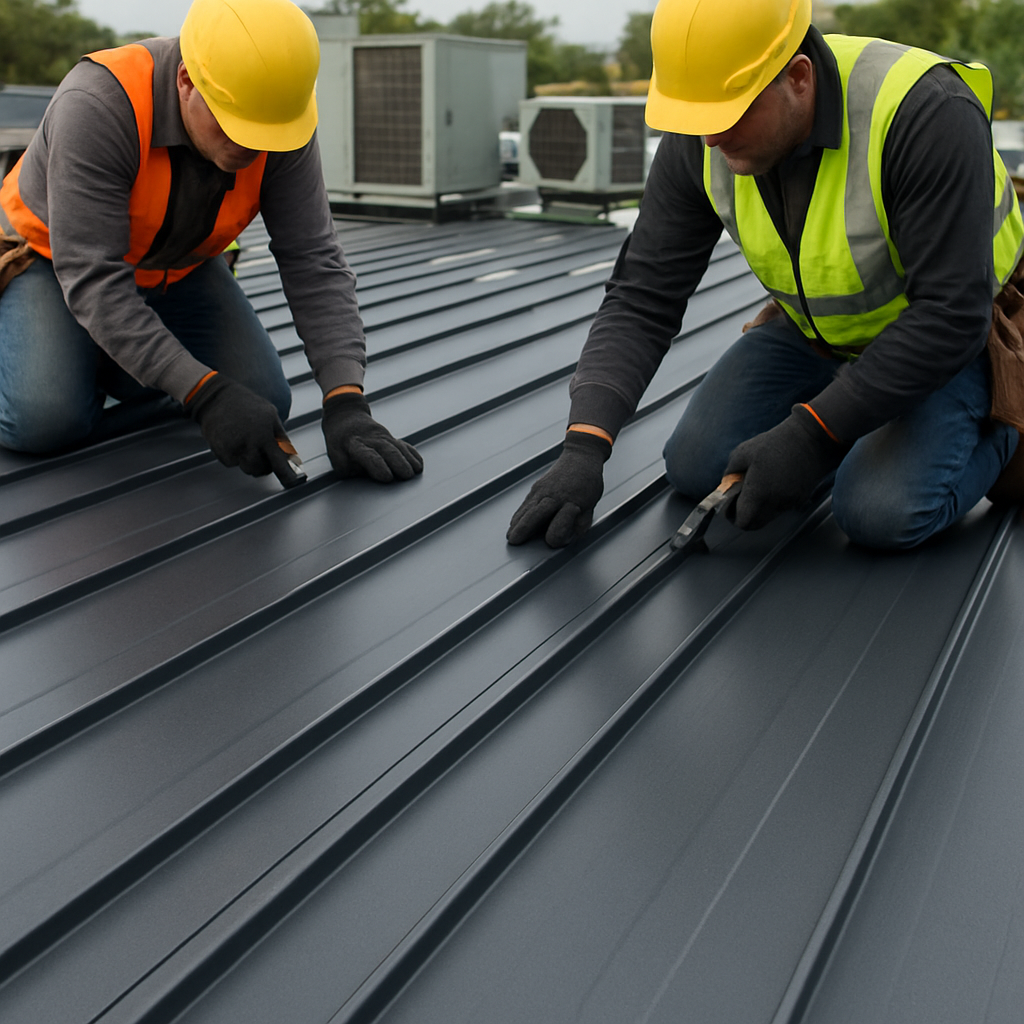
Match performance to priorities: for high-traffic, low-slope commercial roofs prioritize membranes with simple, inspectable seams and proven repair paths; for residential or steep-slope work consider composition shingle options that balance curb appeal and fast replacement schedules. When long-term low maintenance and recyclability matter, standing seam metal is the practical choice despite higher upfront cost.
Practical trade-off: some systems reduce reactive maintenance but demand more skilled installers. For example, single-ply membranes depend on consistent welding technique – a mediocre crew creates chronic seam problems. Conversely, asphalt shingles tolerate more installer variation but require shorter replacement cycles in sun-exposed climates.
| Material | Installed cost band | Service life category | Maintenance notes | Warranty typical |
|---|---|---|---|---|
| Asphalt composition shingles | Low to mid | Medium | Periodic flashing checks, replace damaged shingles | Manufacturer material warranty plus contractor workmanship |
| Single-ply membranes (TPO/PVC) | Mid | Medium to long | Seam inspections and roof traffic controls; quick repairs possible | Manufacturer system warranty when installed by certified applicator |
| Built-up / Modified bitumen | Mid | Medium | Regular surfacing and flashing maintenance; good for complex details | Material warranties plus contractor workmanship |
| Standing seam metal | High | Long | Minimal routine care; watch fasteners, clips, and thermal movement | Often longer manufacturer warranties when installed by certified teams |
Real-world example: A single-tenant retail owner chose standing seam metal for a high-exposure roof to avoid repeated patching and reduce outage windows for loading-dock operations. The owner accepted higher capital cost because supply-chain stability and predictable maintenance windows mattered more than short-term savings; the project used a manufacturer-certified installer and included a documented maintenance plan so future buyers could verify care.
Judgment from practice: owners who chase the lowest installed price usually pay more over the next lifecycle because corner-cutting shows up as chronic leaks, frequent emergency repairs, and premature reroofing. Buy the right system for the roof deck condition, building function, and your capital plan – then buy a contractor with the certifications to prove they can install it.
Choose material for expected use and predictable maintenance, and require installer certification tied to the warranty.
Next consideration: before committing to a material, require a substrate verification scope – core samples, deck assessment, and a written compatibility statement – so the chosen system does not encounter hidden conditions that force a change order or shorten expected life.
6. Choosing a Contractor and Contract Terms That Protect Owners
Practical rule: hire on contract terms, not on charm. Certifications and references narrow the field, but the contract converts promises into enforceable obligations and keeps risks with the party best positioned to manage them.
What to verify before you sign
Baseline vetting: confirm the contractor holds an active license for your jurisdiction, current insurance with named-insured wording, and verifiable safety and payroll records. Ask for at least three recent projects of similar scope and inspect one in person or via timestamped photos. Manufacturer certs matter — require proof of authorized-applicator status for the specific system you choose — but treat those as table stakes, not the whole decision.
- Documentation to demand: license number, insurance certificate with policy numbers and limits, OSHA or safety program summary, copies of manufacturer certification cards, and client contact details for two completed projects.
- Local performance: confirm local crews and supervisors will run the job; out-of-area fly-by teams increase variability and warranty dispute risk.
- Financial protections: for large jobs, require a performance bond or an irrevocable letter of credit to avoid orphaned warranties if the contractor fails.
Contract clauses that change outcomes
Key clauses to include: define measurable acceptance criteria, test requirements, and payment triggers. Vague scopes lead to disputes and change orders; precise specs force the contractor to price and plan accordingly.
- Scope with exclusions and unit prices: list what is included, what is excluded, and unit rates for foreseeable extras such as deteriorated decking or unexpected insulation removal.
- Acceptance tests and deliverables: require a mock-up or 100 sq ft test patch, adhesion or mil-thickness readings, and a documented handover package with O and M instructions.
- Progress payments and retainage: tie draws to milestone evidence (photos, test results) and hold a reasonable retainage until final acceptance and lien waivers are delivered.
- Change order protocol: require written pricing and owner approval for any scope change prior to work; include a maximum markup for subcontractor or material escalations.
- Warranty separation and cure terms: explicitly separate manufacturer material warranties from contractor workmanship warranties, define cure timelines, and require warranty transfer language for future owners.
Trade-off to consider: insisting on a performance bond or higher retainage reduces owner risk but raises bid prices. Expect bids to increase roughly by a low single-digit percentage when contractors factor bonding and cash-flow impacts. That is often a fair exchange for reduced execution risk on larger projects.
Concrete example: an owner required a 100 sq ft adhesion test and 5 percent retainage until test results met the spec. The initial application failed the adhesion test due to inadequate primer; the contractor reworked the prep at their cost and reran the test. The owner avoided accepting a suspect membrane and later costly repairs because the contract tied payment release to objective test results.
Judgment from the field: contractors with great marketing but weak contract discipline are the core source of warranty disputes. If you cannot get a contractor to accept clear acceptance tests and a cure timeline, they will not accept accountability in the field. Make the contract the gatekeeper for quality, then supervise to that standard.
7. Project Planning, Budgeting, and Financing for Building Owners
Straight to the point: poor project planning is the single biggest driver of cost overruns and schedule blowouts on roofing work. Build a funding and execution plan that treats the roof as an asset with a performance window, not a one-off repair. That means converting inspection findings into a prioritized multi-year capital schedule, a scoped budget with explicit allowances, and a financing strategy that matches risk appetite and occupancy constraints.
Capital planning and portfolio prioritization
Create a short-term priority list tied to consequences. Score each roof on two axes: condition confidence (how much you know from testing) and consequence of failure (tenant impact, code risk, insurance exposure). Focus immediate funding on high-consequence roofs even if their condition looks only moderately degraded.
Practical trade-off: consolidating multiple buildings into a single procurement window usually lowers unit cost but increases near-term cash needs and mobilization complexity. In practice, owners with several small roofs often save 8-12 percent by bundling crews and rentals; the catch is coordinating tenancy windows and permits.
Concrete Example: a portfolio owner had 12 small commercial roofs with staggered minor defects. Expert Roofing advised grouping three similar flat-roof replacements into one mobilization. The owner accepted a short-term higher cash outflow and reduced total installed cost through shared scaffolding and shortened warranty administration periods. Tenant disruptions were scheduled overnight and on weekends to protect revenue.
Budget line-items and how to size contingencies
Budget by bucket, not by lump sum. Separate inspection/testing, design/spec, demolition and disposal, substrate remediation, materials and installation, permitting, temporary protections, and closeout/warranty deliverables. This makes vendor bids comparable and exposes the true cost drivers.
- Financing options: vendor financing or phased payment plans for large replacements to smooth capital outlays
- Incentive paths: pursue energy rebates or tax credits for reflective coatings or insulation upgrades via products/roofproducts target=_blank>Energy Star or local utility programs
- Public / alternative finance: consider PACE, municipal financing, or lines of credit for multi-building portfolios
Sizing contingencies requires inspection confidence. If your moisture scans and cores are thorough, the contingency is mainly for price escalation and permit surprises. If testing was limited, budget a larger remediation allowance tied to probable deck failure scenarios. Demand that bidders itemize how they would use that allowance so approvals are not ad hoc change orders.
| Funding route | When it makes sense | Owner impact |
|---|---|---|
| Vendor financing / payment plans | Large single-site replacements where owner prefers to avoid capital draw | Higher long-term cost; faster execution with warranty alignment |
| PACE or energy-linked loans | Projects with measurable energy upgrades or insulation work | Off-balance-sheet potential; requires project qualifying and longer term repayment |
| Bundled procurement across properties | Multiple roofs with similar systems and timelines | Lower unit cost; needs tight scheduling and tenant coordination |
Judgment call: financing reduces near-term pain but shifts risk into debt service and vendor dependence. Use external finance when delaying work increases measurable operational risk (frequent leaks, insurance claims, or tenant loss). Avoid financing purely cosmetic or one-off emergency patches that will be superseded by planned capital replacement.
Next consideration: schedule an independent cost scenario (repair vs. replacement) and a cashflow plan within 45 days to lock permitting windows and contractor availability; without that, you pay premiums for last-minute scheduling and weather delays.
8. Real Project Examples and Decision Outcomes from Expert Roofing
Direct claim: real projects show that the correct decision is almost never the cheapest immediate fix. Owners who match intervention to the roof and business constraints save money and disruption; owners who pick the lowest bid or the easiest option pay repeatedly.
Project snapshots and why the choices made sense
Case 1 – Commercial low-slope TPO: A five-story office roof had scattered seam splits and dry pockets intermingled with older repairs. After targeted core sampling and seam repairs the crew applied a fluid silicone membrane to the repaired areas and high-risk flashings. Decision logic: preserve intact substrate where verified, remediate failure points, then add a seamless layer to extend useful life while planning replacement. Outcome: owner deferred full replacement and avoided tenant outages during peak season by buying planning runway and reducing emergency calls.
Case 2 – Suburban multifamily shingle roofs: Several units showed oxidation and brittle shingles in sun exposed elevations but flashings were generally serviceable. Technicians ran bend tests, cleaned valleys, repaired flashings, and applied a restorative treatment on qualified planes only. Decision logic: selective rejuvenation where physical tests confirm flexibility; replace where shingles fragment under load. Outcome: the owner gained a measurable deferment that aligned with their capital replacement schedule and avoided emergency reroofs during lease turnover periods.
Case 3 – Single tenant retail metal roof replacement: Corrosion and through-fastener leaks had progressed to fastener pull through and deck staining. The team removed the roof and installed a manufacturer certified standing seam system with a transferable workmanship warranty and a documented maintenance plan. Decision logic: active structural degradation and widespread penetration failures required replacement to remove liability and reduce lifecycle costs. Outcome: fewer service calls and a cleaner warranty transfer for resale.
- Practical insight: validate repairable area using objective tests such as infrared scans and cores rather than visual assessment alone
- Trade-off to accept: coatings and restorative treatments reduce near-term disruption but commit owners to inspection discipline and documented maintenance so the temporary fix does not become a hidden liability
- Contract detail that mattered: require a documented compatibility statement when repairs will later be coated or transitioned to a new membrane to avoid removal surprises
What owners often misunderstand: many assume a coating is inherently cheaper long term. In practice coatings make financial sense when they align with a defined capital plan and when substrate testing shows limited hidden deterioration. When residual risk is high, replacing the system is the more predictable economic decision.