
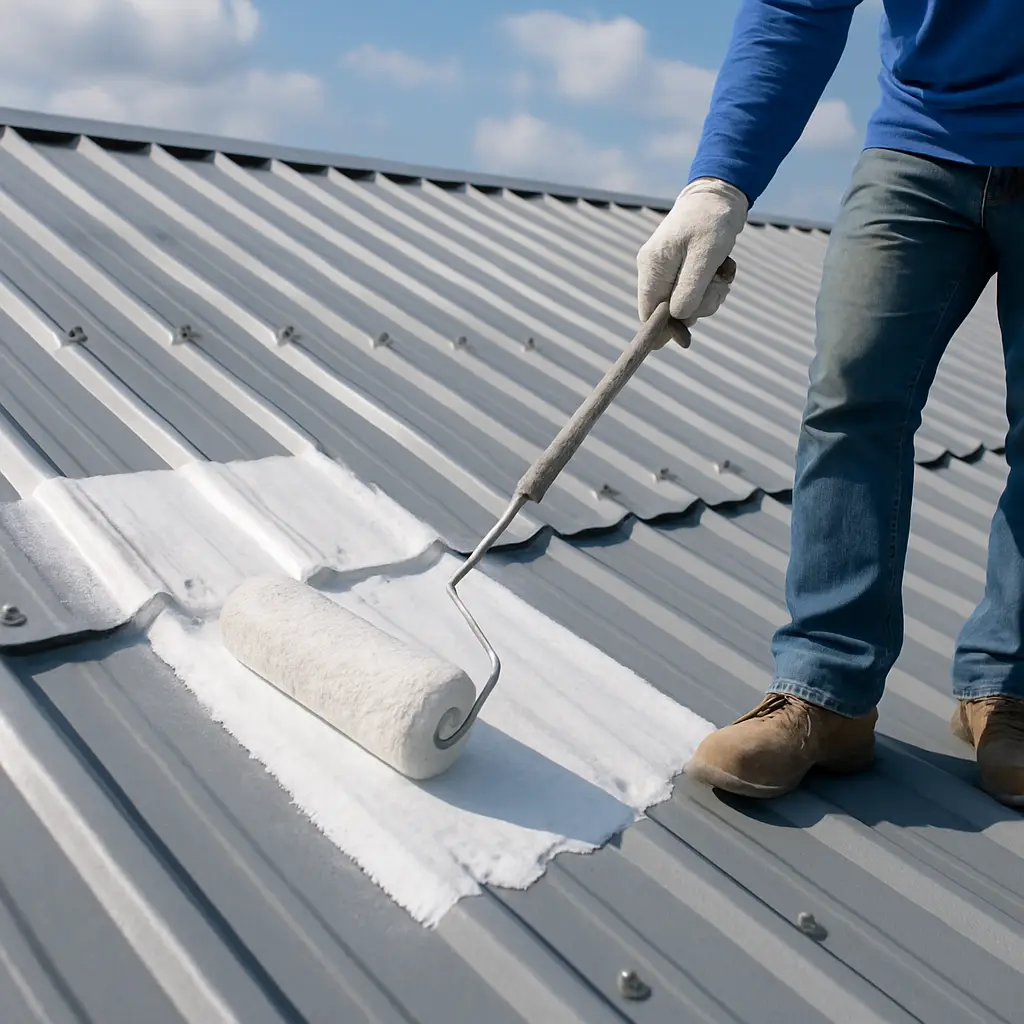
Metal Roof Coatings Explained: Choosing the Right Type for Longevity and Waterproofing
If you manage commercial or residential metal roofs, the right coating can turn a failing roof into a 10 to 20-year asset extension – but the wrong chemistry wastes money and creates callbacks. This guide breaks down metal roof coatings types – acrylic, silicone, polyurethane/polyurea, and asphaltic – and explains how each performs for waterproofing, ponding water, UV exposure, adhesion to metal, and realistic service life. You will get a practical decision framework, surface-prep and primer requirements, typical installed cost ranges, and inspection and maintenance steps to help you choose and specify the right system for your roof.
How coatings protect metal roofs and typical failure modes
Direct claim: Metal roof coatings types protect roofs in two distinct ways: by forming a continuous film that sheds water and by treating or covering vulnerable details like seams, fasteners, and penetrations. A properly specified liquid applied roofing system plus correct detail work stops leaks; chemistry alone does not.
How waterproofing actually works
Mechanisms: Coatings create a continuous membrane over the metal, bridge hairline gaps, and seal fasteners when combined with proper metal roof sealants at laps and penetrations. Some systems are sacrificial – they protect underlying metal because they corrode or chalk first – while others are protective films that rely on adhesion and elasticity to remain intact under movement and UV load.
- Seam and fastener failures: laps that were never sealed or fasteners that have backed out are the most common leak sources.
- Corrosion under coating: rust left under a coating continues to spread and causes delamination.
- Ponding-related breakdown: many coatings (notably conventional acrylics) soften, separate, or wash out where water stands for long periods.
- Thermal cycling fatigue: repeated metal expansion and contraction causes fatigue at seams and at the coating-substrate interface.
- Surface contamination and adhesion loss: oil, mill scale, or poorly removed old coatings cause early failure even with the right chemistry.
Practical trade-off: Choose chemistry for the roof environment, not preference. Silicone roof coatings tolerate ponding and UV far better than acrylics, but they attract dirt and can complicate future recoats unless planned. Acrylic roof coatings buy reflectivity and cost-efficiency on well-drained slopes. Polyurethane and polyurea systems give abrasion resistance for high-traffic service roofs but demand stricter moisture and substrate control during application.
Concrete Example: A single-story warehouse with low slope and chronic ponding received a GacoSystems silicone system after we removed failed acrylic patches, repaired seams with industrial metal roof sealants, and replaced half the fasteners with neoprene-washered screws. The coating stopped interim leaks within weeks and avoided a costly replacement; without seam repairs first, a coating-only approach would have failed within a season.
What typically goes wrong in the field: Contractors often try to mask poor drainage, active rust, or loose panels with a thick coat. That can pass a quick visual inspection but triggers adhesion failures and voided warranties. Always require a documented plan for seam and fastener repair, rust treatment, and an adhesion test per the manufacturer spec or ASTM standards before approving a coating proposal.
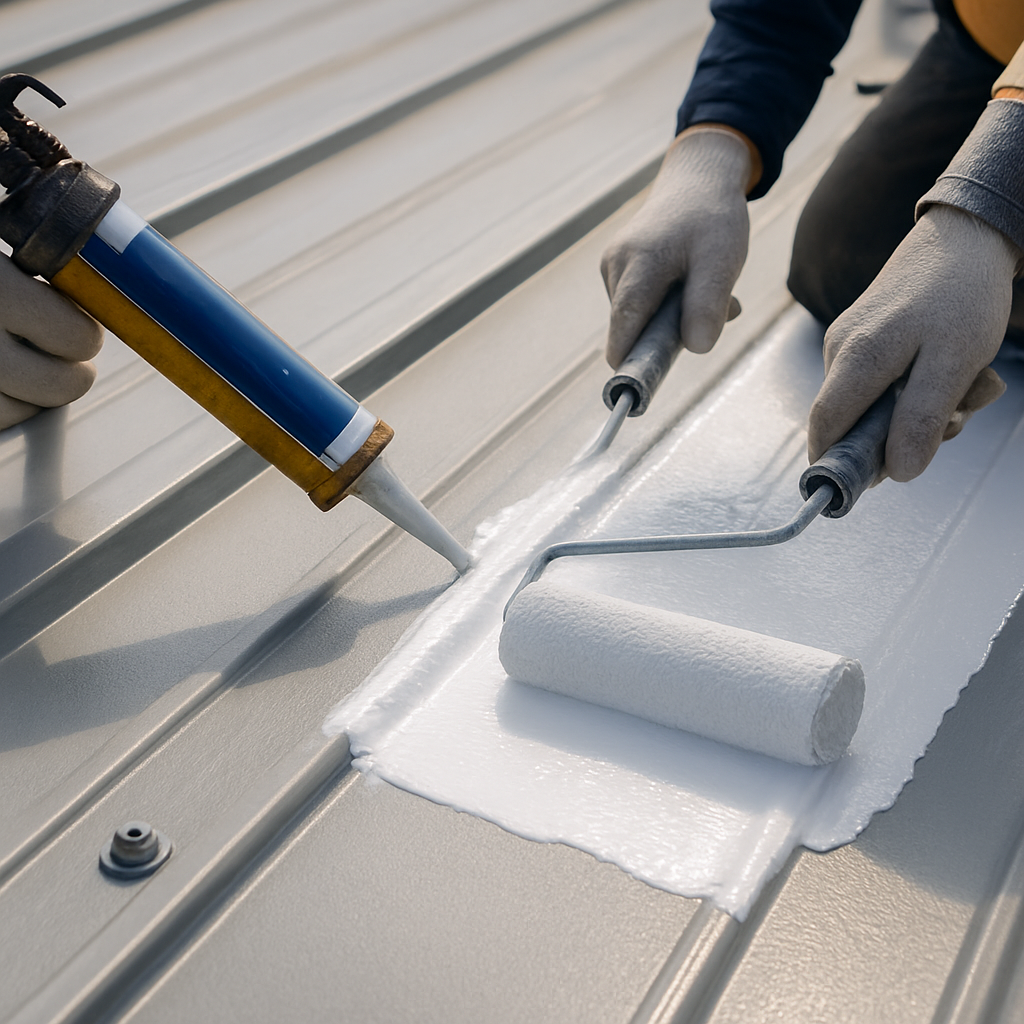
Next consideration: Before accepting bids, insist on a written scope that lists seam and fastener repairs, primer selection, and an adhesion test reference such as ASTM D6083 or manufacturer requirements. If the roof has widespread sectioned corrosion or hidden structural damage, budget for replacement rather than a cosmetic coating.
Comparing metal roof coatings types
Direct point: Different metal roof coatings types trade off waterproofing, durability, and maintenance in predictable ways — pick for the roof condition, not the sticker price. Focus on ponding tolerance, UV resistance, adhesion to prepared metal, and how the system behaves when it gets dirty or needs a recoat.
| Coating type | Ponding water | UV / color stability | Adhesion to clean metal | Flex / elongation | Typical service life | Typical use case / example product |
|---|---|---|---|---|---|---|
| Acrylic (water-based) | Poor for permanent ponding | Good initially; maintains reflectivity | Good on well-prepared, clean metal | Moderate | 5–12 years | Retail or cool-roof upgrades — Sherwin-Williams acrylic systems; Henry Company acrylics |
| Silicone | Excellent – designed for ponding | Excellent UV stability; resists chalking | Very good over primed/clean metal | High | 10–20 years | Low-slope warehouses with standing water — GacoSystems silicone products (gacosystems.com) |
| Polyurethane (aliphatic) | Good if drainage OK | Very good color retention | Good but sensitive to moisture during cure | Moderate–High | 8–15 years | High-traffic rooftop walkways and service decks — Sika or Rhino Linings aliphatic topcoats |
| Polyurea / hybrid | Very good (fast cure) | Good – depends on formulation | Requires experienced applicator; substrate control critical | High | 8–20 years | Industrial roofs needing fast return-to-service; Rhino Linings polyurea systems |
| Asphaltic / aluminum | Variable; not reliable for long-term ponding | Poor color stability; darkens | Good on compatible substrates; limited flexibility | Low | 3–8 years | Flashings or temporary repairs; aluminum roof paints for weatherproofing |
Practical insight: Expect lifecycle decisions to hinge on two real-world constraints: how long water actually stands on the roof and how messy the roof gets. Silicones win where water stands; acrylates win where reflectivity and cost matter; polyurethanes and polyureas win where abrasion and foot traffic are the problem — but only when the applicator controls moisture and substrate conditions tightly.
Concrete example: A regional supermarket replaced worn walkway panels and then specified an aliphatic polyurethane over a moisture-tolerant primer for the service roof. The result: durable abrasion resistance around HVAC units and doors, a warranty acceptable to the operator, and minimal rework over three seasons — something acrylics would have failed at under constant foot traffic.
Judgment: Don’t be seduced by reflectivity claims alone. Cool roof coatings reduce cooling loads, but durability and dirt pickup determine how long that performance lasts. In practice, a reflective silicone in a dusty industrial area often loses performance faster than a dirt-shedding acrylic on a cleaner suburban roof.
Next consideration: Use this comparison to drive your spec: list the acceptable chemistries, required primers, adhesion test method, and permitted applicators. If you want help translating that into a project-ready specification, see our roof coatings service page at Roof Waterproofing Company.
Decision framework: selecting the right coating for waterproofing and longevity
Start with the dominant risk. Decide whether the project is primarily about stopping standing water, halting active corrosion, resisting abrasion from traffic, or preserving reflectivity. Pick the coating family that neutralizes the biggest failure mode rather than chasing the lowest bid.
Four practical steps to a spec-ready decision
Step 1: Diagnose and quantify. Walk the roof after rain and log where water remains after 24 and 72 hours, map rusted areas by percent coverage, note foot-traffic corridors, and record adjacent exposures such as salt spray or chemical drift.
Step 2: Set measurable targets. Require a minimum continuous ponding tolerance, target service life in years, a recoat window, and any CRRC reflectance requirement. These targets turn marketing copy into testable acceptance criteria.
Step 3: Shortlist chemistries by risk profile. Use rules-of-thumb: permanent ponding calls for silicone or engineered polyurea; heavy abrasion or foot traffic favors aliphatic polyurethane or polyurea; tight budget and good drainage can make acrylics the most cost-effective option. Always verify primer compatibility before final selection.
Step 4: Lock the application controls that matter. Require a documented surface-prep plan, adhesion verification (ASTM D4541 or manufacturer method), specified primers, environmental limits for application, and a certified-applicator clause in the purchase order so the warranty stays valid.
- Questions to include in the RFP: What is acceptable ponding duration after a storm? What minimum warranty length is required? Are CRRC ratings required? What VOC limits apply? Who is the approved primer manufacturer?
- Contractor deliverables: Pre- and post-cleaning photos, fastener and seam repair log, adhesion test results, and a measured wet/dry film thickness report.
Practical trade-off to accept up front. You can buy excellent ponding resistance with silicone, but expect higher dirt pickup and a narrower, documented recoat process. Conversely, acrylics hold reflectivity well on clean, well-drained roofs but will fail fast where water stands. Budget and energy goals must bend to the roof environment, not the other way around.
Concrete example: A coastal distribution center with salt spray and several low spots required a moisture-tolerant primer followed by a white GacoSystems silicone system. The project combined targeted seam sealants, fastener replacement, and a specified adhesion test before acceptance; the operator avoided a premature replacement and kept the building watertight through two severe winters. Had the owner insisted on acrylic to chase reflectivity, the coating would have blistered in the standing water zones.
Next consideration: convert these steps into pass/fail contract language and attach them to the purchase order. If you want help turning the diagnosis into a project-ready spec or a contractor shortlist, see our roof coatings service at Roof Waterproofing Company.
Surface preparation, primers, and application specifications that determine success
Start with substrate honesty. Most coating failures trace back to inadequate cleaning, hidden oil, or active corrosion left under the film. When you write a spec for metal roof coatings types, make substrate condition and primer selection the non-negotiable items, not optional extras.
Prioritized surface-prep workflow
Priority actions: Triage the roof into three bands and act accordingly. Light contamination and loose paint – power wash (2,500 to 3,500 psi) with a low-alkaline detergent, then allow full drying. Moderate rust or flaking – mechanically abrade to remove all loose material to bright metal at rust edges and feather the paint. Heavy corrosion or pitting – abrasive blast to a near-white or commercial blast profile and prime immediately.
- Critical check: Verify surfaces are free of oil and silicone residues using a solvent wipe or water-break test before priming
- Fastener and seam work: Replace failed fasteners, re-seat loose panels, and use industrial metal roof sealants at laps before any primer is applied
- Moisture control: Do not coat if substrate temperature is within 5°F of the dew point or if humidity prevents a proper cure
| Substrate condition | Primer recommendation | Why it matters |
|---|---|---|
| Bare, mechanically cleaned steel | High-build epoxy primer such as Sherwin-Williams Macropoxy family | Provides corrosion barrier and strong adhesion for topcoats |
| Weathered painted metal with tight rust | Zinc-rich or epoxy-modified primer (manufacturer specific) | Seals residual rust and improves adhesion for silicone or acrylic systems |
| Galvanized or aluminum | Self-priming silicones or dedicated metal primers from coating manufacturer | Prevents flash corrosion and ensures compatibility with topcoat chemistry |
Application controls that actually save money later. Specify minimum and maximum wet film thickness per coat, cumulative dry film thickness for the system, adhesion testing method (ASTM D4541), and require a documented recoat window. Require the contractor to record ambient temperature, substrate temperature, humidity, and dew point at start and finish of each workday.
Trade-off to accept: More aggressive cleaning increases adhesion and service life but also raises upfront cost and can accelerate metal exposure that must be primed immediately. Budget for the right primer rather than assuming a single universal primer will work for all chemistries.
Concrete Example: On a low-slope retail roof with old oil-based paints, we removed loose coatings, solvent-cleaned to eliminate oil, and applied a Sherwin-Williams epoxy primer compatible with both acrylic and silicone topcoats. The contractor ran an ASTM D4541 pull test on three bays; failing bays received additional abrasion and re-priming before final coats were accepted. That prevented a midterm delamination that often shows up after the first winter.
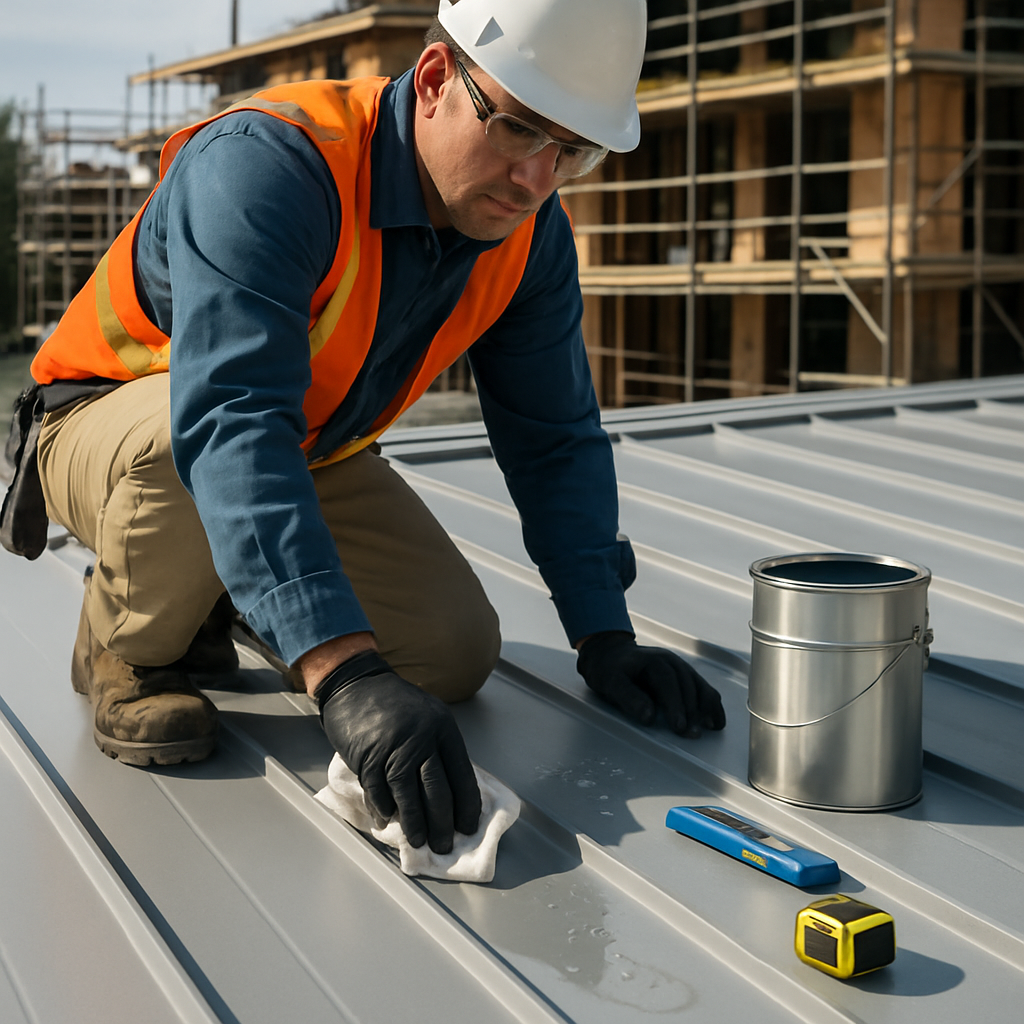
Next consideration: Build these prep and primer requirements into the RFP and require them as subcontractor deliverables. If you want a contractor-ready spec or a pre-bid site survey, see our roof coatings service at Roof Waterproofing Company.
Installed cost ranges and lifecycle value
Reality check: Installed price is only the starting point — surface prep, detail repairs, primers, testing, and access logistics typically determine whether a coating delivers value or becomes a recurring expense. Don’t price-shop chemistry alone; price the whole scope that produces a watertight, warrantable system.
Typical installed cost bands (ballpark): Acrylic systems commonly land at around $0.60 to $2.00 per sq ft, silicone systems near $1.50 to $4.50 per sq ft, polyurethane and polyurea systems roughly $2.50 to $6.50 per sq ft, and asphaltic/aluminum coatings about $0.50 to $1.50 per sq ft. These ranges cover complete installed systems but do not include large-scale metal repairs, structural replacement, or specialized traffic coatings.
Hidden line items that change project economics: Expect seam and fastener work, rust remediation, primer selection, and adhesion testing to add material and labor. For example, replacing 10 percent of fasteners on a 20,000 sq ft roof at $1.50 per fastener adds roughly $0.15 per sq ft — small per square foot but meaningful when evaluating low-bid acrylics versus a higher-cost silicone with fewer callbacks.
How to compare lifecycle value, simply: Convert proposals to an annualized cost per sq ft by dividing installed system cost by the owner’s target service life, then adjust that annualized number for expected maintenance and energy impacts (reflectivity gains or losses). The lowest installed price can still be the most expensive per year if the system needs earlier recoats or fails in ponding zones.
Concrete example: A 40,000 sq ft warehouse has two bids: an acrylic system at $1.00/sq ft and a silicone at $3.00/sq ft. If the owner expects the acrylic to require more frequent localized repairs (and a recoat sooner) because of chronic low spots, the silicone’s higher initial cost can be justified by fewer callbacks and stable waterproofing — shifting the decision from lowest bid to lowest expected annual cost and operational disruption.
Judgment you need to apply: Spend on correct prep and the right chemistry for the roof exposure. Cheap acrylics on ponding roofs are a false economy; expensive polyurethanes or polyureas bought to solve traffic problems fail if moisture controls and primers are ignored. Specify acceptance criteria (adhesion test, WFT/DFT records, primer batch numbers, certified applicator) and price those requirements into every bid.
Inspection, maintenance, and recoating strategies to protect investment
Routine inspection saves replacements. Match inspection cadence to exposure and the chosen metal roof coatings types: high-salt, high-traffic, or ponding-prone roofs need more frequent checks than clean, well-drained suburban roofs. The inspection program should be measurement-driven, not just visual, so problems are caught while repairs are local and inexpensive.
What to inspect and how to measure it
- Visual scan: Walk every bay and photograph suspect areas with date stamps. Note blistering, runs, seam wetness, and areas where the coating looks different under reflected light.
- Ponding log: Map spots that retain water 24 and 72 hours after a rainfall – mark these as re-inspect priorities and potential triggers to avoid acrylic topcoats.
- Adhesion checks: Perform ASTM D4541 or a manufacturer-accepted pull test on representative bays before accepting work and every 3 to 7 years thereafter.
- Surface cleanliness index: Use a simple water-break test or solvent wipe protocol to confirm no oil, salt, or silicone contamination before any recoat.
- Seam and fastener audit: Torque or replace suspect fasteners and verify seam sealant condition; fastener failures are still the most common cause of leaks.
Maintenance choices are tradeoffs. For example, silicone roof coatings resist ponding and UV but collect dirt faster and lose measured solar reflectance sooner in dusty settings; aggressive washing restores reflectivity but risks abrading weaker topcoats. Plan cleaning frequency to balance waterproofing, reflectivity, and the coating chemistry you selected.
Concrete example: A 60,000 sq ft distribution center with a white silicone system adopted an annual soft-wash and debris clearing regime plus targeted adhesion spot-tests every four years. After three seasons the crew performed small-area localized patching at seam terminations; the owner deferred full recoating until signs of adhesion loss appeared in year eight, avoiding unnecessary midterm costs while keeping the roof watertight.
Recoating triggers and a practical 20-year timeline
- Year 0 – Baseline: Record pre-acceptance photos, adhesion test results, WFT/DFT records, primer and topcoat product and batch numbers, and applicator certification.
- Annually: Clear drains, remove debris, inspect identified ponding spots, and log any new fastener or seam movement.
- Every 3 to 5 years: Run adhesion spot-tests in high-stress areas (walkways, ponding edges). Perform localized patching with compatible metal roof sealants and compatible patch materials as needed.
- Recoat trigger: Initiate broader recoating when adhesion tests fail, continuous chalking reduces reflectivity beyond acceptable limits, or when more than about 10 to 15 percent of pre-identified high-risk bays show deterioration.
- Major recoating window: Plan for full-system recoats on the expected end of life for the chosen chemistry – but verify substrate condition and re-prep before any recoat, because silicones and some elastomerics have narrow recoat requirements.
Important: require an adhesion test before you accept a final coat and again before a recoat – documented failures are the most defensible reason to compel corrective work under a warranty.
If you do not have the internal expertise to build and enforce this schedule, commission a roof survey and a written maintenance plan tied to the coating specification. See our roof coatings service at Roof Waterproofing Company or consult NRCA guidance for standards-based inspection templates.
Takeaway: Tie inspection frequency and recoating triggers to the chosen chemistry and roof exposure. Well-documented, regular small repairs and adhesion testing avoid large replacements and keep warranties valid.
Real-world examples and product references
Immediate point: When you narrow choices among metal roof coatings types, the next step is mapping real products to real roof problems — not slogans. Manufacturer families and primers matter because warranty language, recoat windows, and application methods differ as much as the chemistry does.
Product families and where we actually use them
Silicone for chronic ponding: We choose GacoSystems silicone products for low-slope warehouses and distribution centers where water stands for days. They keep leaks out and resist UV degradation, but expect heavier dirt pickup and plan for the manufacturer recoat procedure because silicone residues and surface chalking can impede future adhesion — cleaning is non-negotiable before any recoat. See GacoSystems for technical data.
Acrylics for clean, well-drained roofs: In suburban retail or residential metal roofs with good slope, Henry Company and Sherwin-Williams acrylic roof coatings buy reflectivity and low cost. They perform well on properly primed metal but fail where standing water persists; if energy-efficiency incentives drive the decision, require CRRC-rated products and a dirt-management plan to preserve solar reflectance.
Polyurethane/polyurea where abrasion or quick return-to-service matters: For rooftop walkways, service decks, or municipal parking structures we specify aliphatic polyurethane or fast-cure polyurea systems from suppliers such as Rhino Linings or Sika. These systems resist impact and foot traffic, but they demand strict moisture control during application and an experienced spray crew — getting the cure wrong is the usual failure mode, not the chemistry itself.
- Primer and substrate reality: Use zinc-rich or epoxy primers (eg. Sherwin-Williams Macropoxy family) on abraded steel to get long-term corrosion resistance; galvanized surfaces often need manufacturer-recommended metal primers or self-priming silicones.
- Compatibility trap: Do not assume a topcoat from one family will adhere to a different-family primer without testing. Require an adhesion test or manufacturer confirmation before accepting supplier substitutions.
- Application method matters: Roller and squeegee applications are forgiving but slower; spray-applied polyureas cure too fast for inexperienced crews and can trap moisture under the film if weather controls are lax.
Concrete example: A municipal hospital needed a fast turnaround on a penthouse roof above critical services. We specified a fast-curing polyurea membrane applied during an overnight shutdown so HVAC remained operational the next morning. The owner accepted higher cost for the rapid cure and lower disruption; the contractor documented substrate dryness and ran adhesion tests immediately after cure to qualify the warranty.
Trade-off to accept in procurement: If you pick silicone for waterproofing, price and plan for periodic pressure-washing to restore reflectivity; if you pick polyurethane for durability, budget for stricter prep and weather windows. In practice, owners underestimate cleaning and adhesion verification costs — those items decide whether a high-performance product becomes an asset or a recurring problem.
Next consideration: Before you accept bids, ask suppliers for system datasheets, certified-applicator lists, and a sample adhesion test plan — and refer contractors to our roof coatings service at Roof Waterproofing Company roof coatings service for specification help or a pre-bid survey. If you skip that step, you leave warranty eligibility and long-term waterproofing to chance.