
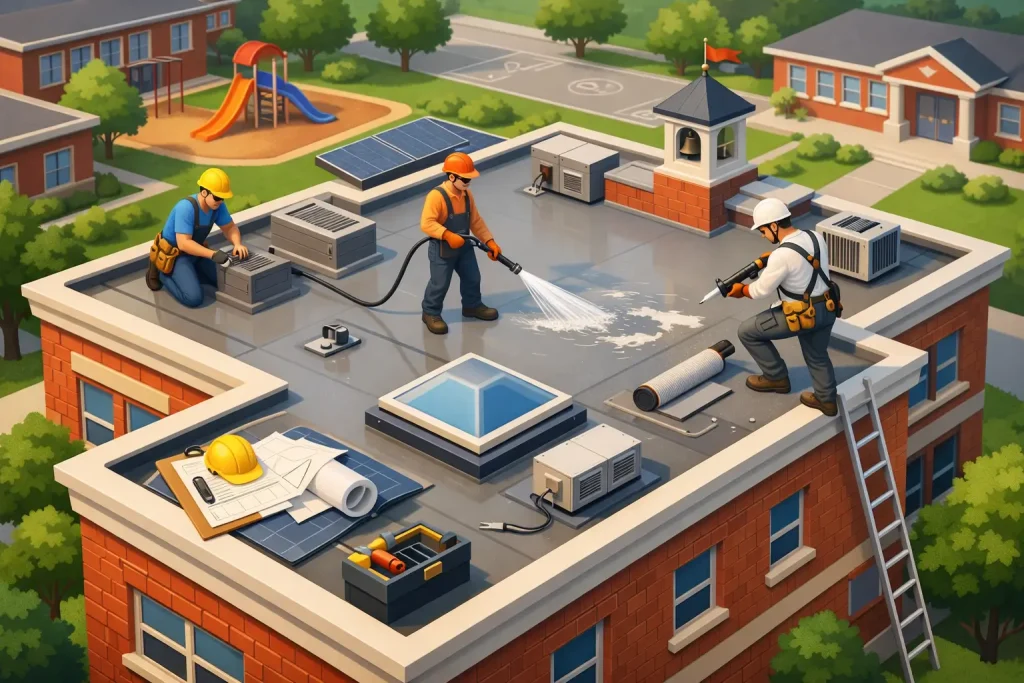
A leaking school roof rarely starts as a crisis. It usually starts as a small seam opening, a clogged drain, a cracked flashing edge, or ponding water nobody had time to address last semester. Then a hard rain hits, a ceiling stain spreads, and now classes are being moved, equipment is at risk, and the budget takes a bigger hit than it should have. That is exactly why a school roof maintenance program matters.
For school leaders, facility managers, and property teams, the goal is not just fixing leaks faster. The goal is keeping buildings open, protecting staff and students, and stretching every roofing dollar as far as it can go. In South Mississippi, that pressure is even higher. Heat, humidity, wind-driven rain, and storm season can age a roof faster than many people expect.
What a school roof maintenance program should actually do
A good school roof maintenance program is not a stack of inspection forms that sit in an office. It is a working plan built around prevention, documentation, and timely repairs. The program should help a school district know what roof systems it has, what condition they are in, where the weak points are, and what work needs to happen now versus later.
That matters because schools rarely have just one roof type. A campus may have low-slope roofs over classrooms, metal roofing over walkways, shingle systems on smaller structures, and waterproofing details around equipment curbs, drains, skylights, and wall transitions. Each area ages differently. If nobody is tracking those conditions, the district ends up reacting instead of planning.
The strongest programs focus on three things. First, they catch small issues before they become interior damage. Second, they create a repair history that supports budgeting and warranty protection. Third, they help schools decide whether a roof needs repair, restoration, coating, or replacement based on actual condition instead of guesswork.
Why schools need a different maintenance approach
School buildings are not simple properties. They stay busy, they have strict schedules, and they carry a lot of liability. When a roof problem shows up, it affects more than the building envelope. It can interrupt testing, damage electronics, create slip hazards, and lead to mold concerns if moisture lingers.
That is why a school roof maintenance program should be built around the school calendar and operational reality. Summer may be the best time for larger repairs, but inspections should not wait for summer. A roof should be looked at before storm season, after major weather events, and at regular intervals during the year.
There is also a cost issue. Emergency repairs are usually the most expensive way to manage a roof. They happen on short notice, often after water has already entered the building, and they may expose problems that have spread beyond the original leak point. Planned maintenance costs less because it gives schools room to prioritize and schedule work in a controlled way.
What should be included in the program
The first step is a complete roof inventory. Every building should be listed with roof type, age, size, past repair history, and known trouble areas. Without that baseline, one campus can get all the attention while another roof quietly deteriorates.
From there, inspections need to be consistent and practical. That means checking membrane condition, seams, penetrations, coping, edge metal, drainage, flashings, wall transitions, rooftop units, and signs of standing water or movement. On metal roofs, fasteners, panels, laps, and sealant details need close attention. On older roofs, the question is not just whether there is a leak today, but whether the system is still performing well enough to justify repair.
A good maintenance plan also includes routine cleaning and minor corrective work. Drains need to stay open. Debris needs to be removed. Sealants need to be reviewed, not assumed to be fine because they looked acceptable a year ago. Small punctures, loose flashing, and failed details should be corrected early. Those are low-cost fixes compared with replacing wet insulation, ceiling tile, and damaged interior finishes.
Documentation is another big piece. Photos, written condition notes, repair logs, and recommendations help school administrators make informed decisions. They also make it easier to compare bids, justify budget requests, and show that the district is taking reasonable steps to protect its facilities.
Repair, restore, or replace? It depends on the roof
One of the most common mistakes schools make is treating every aging roof like a replacement job. Sometimes replacement is the right move. If a roof has widespread saturation, failing structure, major system breakdown, or has simply reached the end of its service life, patching it over and over does not save money.
But not every older roof is a lost cause. In many cases, a restoration strategy can buy valuable time and extend service life at a lower cost than tear-off. That is especially true when the roof is still structurally sound but has surface wear, minor leaks, or waterproofing weaknesses. Roof coatings can be a strong option on certain systems, but only after the roof is properly assessed and prepared. A coating is not a shortcut for bad substrate conditions.
That is where an experienced contractor brings real value. Schools need someone who can look at the roof honestly and explain the trade-offs. A lower upfront number is not always the cheapest path if the roof keeps failing. On the other hand, a full replacement is not always necessary if targeted repairs and restoration can deliver several more years of reliable performance.
Budget planning works better when the roof data is real
Most schools are balancing roof work against HVAC upgrades, paving, safety needs, and a long list of capital demands. The roofing budget usually gets squeezed until a leak makes it urgent. That is understandable, but it creates a cycle of deferred maintenance that gets expensive fast.
A school roof maintenance program gives administrators something better than rough estimates. It gives them a current picture of roof condition and a phased plan. Maybe Building A needs immediate drainage correction, Building B is a candidate for coating next year, and Building C should be scheduled for replacement in two budget cycles. That kind of planning is far easier to defend than emergency spending after the damage is already visible.
For districts across the Gulf Coast, weather risk should be part of that planning. High winds, tropical storms, and heavy rain can turn a borderline roof into a failure point quickly. Annual inspection data helps schools decide where to strengthen weak areas before storm season puts the roof to the test.
Choosing the right contractor for school roof maintenance
Schools should not be looking for the cheapest company with a ladder and a patch kit. They need a contractor that understands commercial roof systems, waterproofing details, and the difference between a temporary fix and a durable repair. They also need responsiveness. When a school calls about an active leak, waiting days for a callback is not acceptable.
A dependable contractor should be able to inspect, document, recommend, and perform the work without making the process harder for school staff. Clear scopes, realistic pricing, warranty knowledge, and the ability to work around occupancy matter. So does experience with restoration and coatings, because those options can make a major difference when replacement funding is tight.
For schools in Biloxi and across South Mississippi, local weather experience matters too. Roofing decisions that might hold up in a mild climate can fail faster here. Salt air, humidity, intense sun, and storm exposure all change how materials age and how repairs should be handled.
School roof maintenance program mistakes to avoid
The biggest mistake is waiting for interior leaks to define the roof condition. By the time water shows up inside, the problem has often been developing for a while. Another mistake is assuming all roofs on campus should be handled the same way. Age, slope, material, traffic, and drainage all change the maintenance strategy.
Schools also run into trouble when they approve repeated spot repairs without stepping back to ask whether the roof still makes financial sense to maintain. If the same area keeps failing, the issue may be larger than the visible leak. And if maintenance records are incomplete, it becomes harder to tell whether the district is preserving a roof or just chasing symptoms.
A stronger approach is simple. Inspect regularly, repair early, document everything, and make decisions based on condition instead of habit. That is how schools stay ahead of leaks, avoid unnecessary replacement, and protect the buildings they count on every day.
If your campus roofs are aging, showing signs of leaks, or costing more in reactive repairs than they should, now is the right time to put a real maintenance plan in place. A school roof does not have to fail before it gets attention, and the schools that act earlier usually spend smarter.