
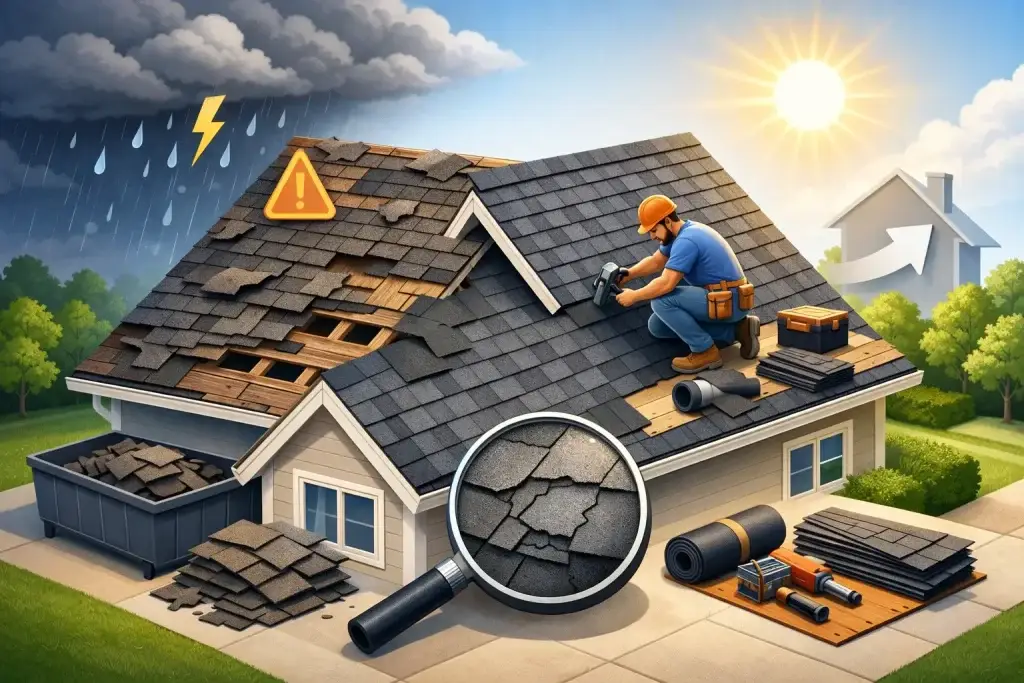
A roof does not usually fail all at once. It starts with a lifted tab after a storm, a dark spot on the ceiling, granules in the gutter, or shingles that look tired from the street. In South Mississippi, that slide can happen faster than many owners expect. Heat, humidity, wind, and driving rain are hard on asphalt systems, which is why shingle roof replacement often becomes the smarter move before a small problem turns into interior damage, insurance headaches, or repeat repair bills.
For some properties, a targeted repair is enough. For others, patching the same roof again and again wastes money. The real question is not whether shingles can be repaired. It is whether the roof still has enough life left to justify more repairs.
When shingle roof replacement makes more sense than repair
Age matters, but condition matters more. A roof that is nearing the end of its service life and already showing widespread wear usually does not benefit much from another patch. If shingles are curling, cracking, losing granules, or blowing off in multiple areas, the system is telling you it is wearing out. If leaks keep showing up in new spots, there may be deeper issues with underlayment, decking, flashing, or ventilation.
Storm exposure also changes the equation. Along the Gulf Coast, even one bad weather event can push an older roof past the point where repair is a good investment. Wind can break the seal on shingles that still look decent from the ground. Hail can bruise the mat and shorten the remaining life of the system. In those cases, replacing the roof can restore dependable protection instead of leaving you with a roof that looks fixed but is still vulnerable.
There is also the cost side. One repair is manageable. Several repairs over 12 to 24 months are usually a sign that the money would be better spent on a full replacement with a warranty. Property owners who plan to stay in place often come out ahead by making the change once instead of chasing leaks through every storm season.
What a good shingle roof replacement should include
A proper replacement is more than nailing down new shingles. If the job is rushed or built on top of hidden damage, the new roof may not perform the way it should. That is why inspection and preparation matter as much as the finished look.
The old roofing material needs to come off so the deck can be checked. Soft spots, rot, or water damage should be addressed before new materials go on. Flashing around penetrations, valleys, walls, and chimneys should be evaluated carefully because many roof leaks start at those transitions, not in the field of the shingles themselves.
Ventilation is another part that gets overlooked. A roof in a hot, humid climate needs balanced intake and exhaust airflow. Without it, attic heat builds up, moisture gets trapped, and shingles can age faster than expected. For homeowners dealing with high cooling bills, this is one of the moments when roof work and attic performance should be looked at together.
Material selection matters too. Not every shingle is the same. Some are built for stronger wind resistance, heavier weather exposure, and longer warranties. That does not always mean the most expensive product is the right one. It means the system should match the property, the budget, and the local conditions.
How to tell if your roof is worn out or just weathered
A roof can look old without being finished, and it can look decent while hiding real problems. That is why a close inspection is worth more than a guess from the driveway.
If the shingles have isolated damage from one recent event, repair may still be a practical option. If the wear is spread across multiple elevations, the roof is nearing the point where replacement should be planned. Watch for bald-looking shingles, exposed fiberglass mat, repeated leaks, sagging areas, soft decking underfoot, algae streaking tied to moisture retention, and shingles that no longer lie flat.
Inside the building, signs can show up before a major leak. Stains in the attic, damp insulation, mold smell, peeling paint near the ceiling line, and unexplained moisture around light fixtures can all point back to roof failure. Commercial owners and facility managers should also pay attention to tenant complaints, because recurring water entry often starts as a small nuisance before it becomes a larger liability.
The timeline and what to expect during a roof replacement
Most property owners want to know two things right away: how disruptive the job will be and how long it will take. The answer depends on roof size, weather, complexity, and whether damaged decking has to be replaced. A straightforward residential project may move quickly. A larger home, a steep roof, or a property with multiple penetrations and problem areas can take longer.
The process should start with a clear inspection, a written scope, and straightforward pricing. If insurance is involved, documentation becomes especially important. After that, materials are scheduled, tear-off begins, damaged components are replaced as needed, and the new system is installed and cleaned up. Good contractors do not leave you wondering what happens next. They communicate the schedule, explain any hidden damage they find, and keep the project moving.
Noise is part of the process. So is some disruption around the property. What should not be part of the process is confusion. If a contractor cannot explain the system, the timeline, or the warranty in plain language, that is a problem.
Cost, financing, and the real value of doing it now
Shingle roof replacement is a major purchase, but waiting too long can be more expensive. Once water gets inside, the roof is no longer the only issue. You may be dealing with insulation damage, sheetrock repairs, interior paint, decking replacement, or even electrical concerns. On commercial properties, tenant disruption and downtime can drive costs even higher.
Price depends on roof size, pitch, material choice, accessibility, decking condition, and the amount of flashing or detail work involved. That is why honest estimates matter. A low number that leaves out key components is not savings. It is just delayed cost.
For many owners, financing helps move the project forward before the next storm creates a bigger emergency. That can make the decision easier when the roof needs replacement now but the budget was built around later. The better question is not just what the project costs today. It is what delay is likely to cost over the next season.
Why local weather changes the replacement decision
On the Gulf Coast, roofs age under tougher conditions than in milder parts of the country. Constant sun exposure dries materials out. Heavy rain tests every seam and flashing point. High winds can loosen shingles long before a leak shows up inside. Salt air near the coast can also add wear over time, especially around metal components.
That is why replacement decisions in places like Biloxi and nearby South Mississippi communities are often more urgent than owners first think. A roof that might limp along in another region can fail fast here. If your roof is already showing wear, storm season is not the time to gamble on one more repair.
This is also where working with a contractor that understands both replacement and restoration options matters. Some roof problems really do call for a new shingle system. Others may involve adjacent waterproofing, ventilation, guttering, or exterior repairs that need to be handled at the same time to protect the full building envelope.
Choosing a contractor for shingle roof replacement
The cheapest bid is rarely the safest one. You want a contractor with real experience, clear communication, insurance-backed professionalism, and a record of finishing jobs the right way. Ask what materials are being used, what warranty is included, whether damaged decking is addressed as needed, and who is responsible for cleanup and site protection.
You should also expect practical recommendations, not pressure. A dependable contractor will tell you when repair is still reasonable and when replacement is the smarter move. That kind of honesty matters because every roof is different. A homeowner with a storm-damaged 12-year-old roof is not in the same position as a property manager dealing with recurring leaks on a worn-out 25-year-old system.
Expert Roofing works with property owners across South Mississippi who need answers fast, fair pricing, and a roof system built to hold up. That means looking at the full problem, not just the most visible symptom.
If your roof is showing its age, this is the time to get it checked before the next leak decides for you. A solid roof does more than keep water out. It protects the value of the property, the people inside it, and your peace of mind when the weather turns rough.