
A flat or low-slope roof can look fine from the ground while water is working its way through an open seam, damaged flashing, or clogged drain. This TPO roofing guide gives Gulf Coast property owners the straight answer on what TPO does well, where it needs careful installation, and when repair, restoration, or replacement makes the most financial sense.
What Is TPO Roofing?
TPO stands for thermoplastic polyolefin. It is a single-ply roofing membrane commonly installed on commercial buildings, multifamily properties, hotels, offices, retail centers, warehouses, and homes with low-slope roof sections.
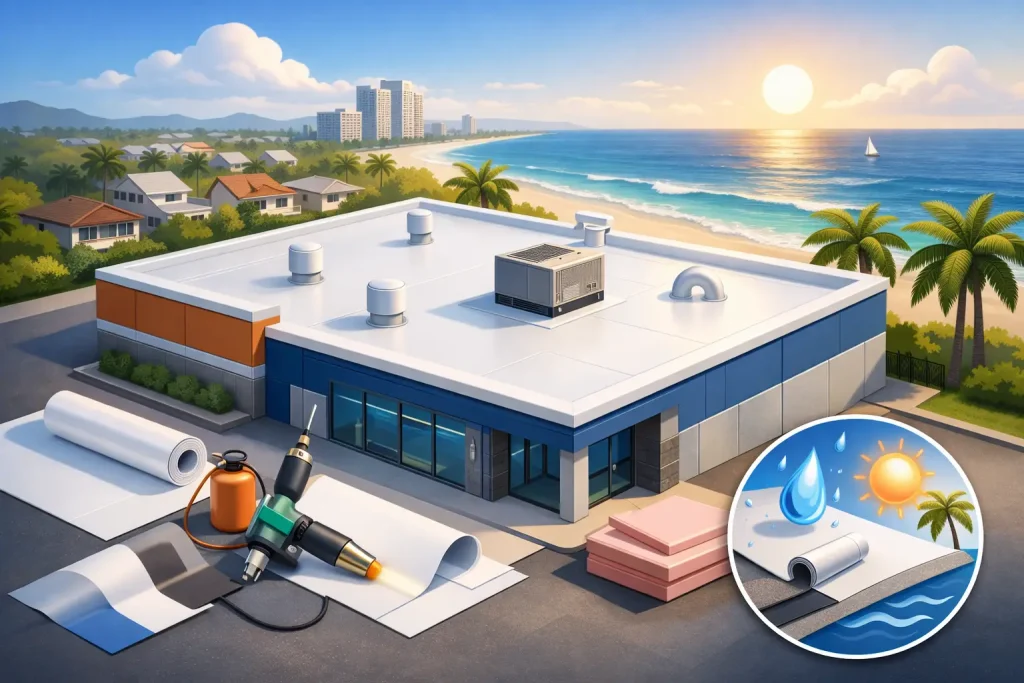
The membrane is typically white or light colored, which helps reflect sunlight and reduce heat absorbed by the roof surface. TPO is sold in large rolls, then secured over insulation or an approved roof deck. Its seams are heat-welded with specialized equipment, creating a continuous waterproofing surface when the work is done correctly.
That last point matters. TPO is not just a sheet laid across a roof. Its long-term performance depends on welded seams, properly detailed penetrations, secure perimeter edges, drainage, and flashing around every wall, pipe, curb, and rooftop unit.
For South Mississippi property owners, TPO can be a practical choice because it combines heat reflectivity with strong waterproofing potential. But it must be designed for Gulf Coast rain, wind exposure, humidity, and the occasional hard-hitting storm.
Why Property Owners Choose TPO
TPO has become a popular low-slope roofing option because it delivers several practical benefits without the weight of a built-up roof system. A bright white TPO membrane can reduce rooftop temperature and may help ease air-conditioning demand during long, hot summers. Actual energy savings depend on insulation levels, building use, thermostat settings, and the condition of the rest of the building envelope.
The hot-air welded seams are another major advantage. Unlike systems that rely mainly on adhesives or asphalt-based seams, properly welded TPO seams become a strong part of the membrane assembly. This is especially valuable on roofs that see standing water after heavy rain.
TPO is also flexible enough to work around many rooftop details. HVAC curbs, plumbing vents, drains, skylights, scuppers, and parapet walls can all be flashed as part of the system. For a facility manager with a complicated roof full of equipment, that detail work is often more important than the membrane brand printed on the roll.
Cost is a reason many owners consider TPO, but it should be viewed as lifecycle cost rather than just a price per square. A less expensive installation that leaves weak flashing, poor drainage, or loose edges can become an expensive leak problem fast. The right scope balances material thickness, insulation needs, wind requirements, roof access, and warranty coverage.
TPO Roofing Guide: 45 Mil, 60 Mil, or 80 Mil?
TPO membrane thickness is usually measured in mils. Common choices include 45 mil, 60 mil, and 80 mil. A mil is one-thousandth of an inch, and the best thickness depends on how the building is used and how much abuse the roof is likely to take.
A 45-mil system may be suitable for a lower-risk roof with limited foot traffic and a properly protected surface. It can be a budget-conscious option, but it provides less material for long-term weathering and future repair work.
A 60-mil TPO roof is often a strong middle ground for many commercial properties. It offers more durability than 45 mil without pushing every project into the highest material cost category. For many businesses and multifamily properties, it is worth discussing as a baseline option.
An 80-mil membrane is often the better call where roof traffic, rooftop equipment service, ponding water, or long-term ownership plans demand extra protection. Schools, hotels, industrial buildings, and facilities with frequent HVAC access may benefit from the additional thickness, especially when paired with designated walk pads.
Thickness alone does not make a roof storm-ready. The attachment pattern, edge metal, fasteners, decking condition, insulation layout, and flashing details all affect wind resistance. A contractor should inspect those conditions before recommending a system.
How a TPO Roof Is Installed
A quality TPO installation begins with the roof underneath it. If the deck is damaged, wet insulation is left in place, or old leaks have weakened the structure, simply covering the problem is not a lasting repair.
After inspection and preparation, the roofing team determines whether the existing roof can support a recover system or whether a tear-off is necessary. A recover can reduce disruption and disposal costs in some situations. However, it is not appropriate when trapped moisture, saturated insulation, unstable decking, or too many existing roof layers are present.
The crew then installs insulation as needed, lays out the membrane, and attaches it through a mechanically fastened, fully adhered, or ballasted system when appropriate. Mechanically fastened TPO is common and efficient, while fully adhered systems can be useful where appearance, wind design, or specific building conditions call for them.
Seams are hot-air welded and tested. Flashing is installed at walls, drains, penetrations, curbs, and roof edges. The final walk-through should include checking seams, edge securement, drainage paths, and clean-up around the property.
A good contractor does not rush this phase. Many roof leaks start at transitions and penetrations, not in the open field of the membrane.
The Gulf Coast Issues That Cannot Be Ignored
A TPO roof in Biloxi, Ocean Springs, Pascagoula, or elsewhere along the Coast deals with more than summer heat. Wind-driven rain can force water into weak edge details. Tropical weather can test membrane attachment and rooftop equipment curbs. Humidity can make hidden moisture in insulation a serious concern.
Drainage deserves special attention. TPO can handle wet conditions, but persistent ponding water is still a warning sign. Water that remains on the roof for more than a couple of days after rain may point to blocked drains, poor slope, settled insulation, or structural deflection. Ignoring it can shorten the service life of nearly any low-slope roofing system.
Salt air may also affect metal components at the roof perimeter and around equipment. That is why compatible, properly coated edge metal and regular inspections are worth the investment for coastal properties.
Repair, Coating, or Replacement?
Not every TPO problem means the roof needs to be replaced. If the membrane is generally sound and the issue is isolated, a professional repair may be the right answer. Open seams, punctures, failing pipe boots, loose termination bars, and damaged flashing can often be addressed before water reaches the deck and insulation.
A roof coating may be an option in certain restoration situations, but it is not an automatic fix for every aging TPO roof. The membrane must be clean, dry, compatible with the selected coating, and structurally sound. Active leaks, wet insulation, failing seams, and poor drainage need to be corrected first. Coating a roof with underlying defects can hide trouble instead of solving it.
Replacement becomes the smarter investment when leaks are widespread, insulation is saturated, seams are failing across large areas, or the roof has reached the end of its serviceable life. A thorough inspection helps separate a repairable issue from a roof that is costing more to maintain than it is worth.
Maintenance That Protects Your Investment
A TPO roof should be inspected at least twice a year and after major storms. Property owners and maintenance teams should keep drains, scuppers, and gutters clear, but avoid scraping the membrane or using harsh chemicals that can damage the surface.
Keep unauthorized foot traffic to a minimum. Service technicians working on HVAC equipment should use designated walk pads, and anything dropped or dragged across the roof should be checked immediately. Small punctures are far easier and less expensive to repair before a storm pushes water below the membrane.
Document inspections, repairs, and storm events. For commercial owners, that record can support maintenance planning, warranty compliance, and insurance discussions after wind or hail damage.
When a low-slope roof starts showing stains, ceiling leaks, standing water, or loose flashing, waiting rarely saves money. Expert Roofing can inspect the roof, explain the practical options, and provide a free estimate for repair, restoration, or a full TPO replacement built for Gulf Coast conditions.