
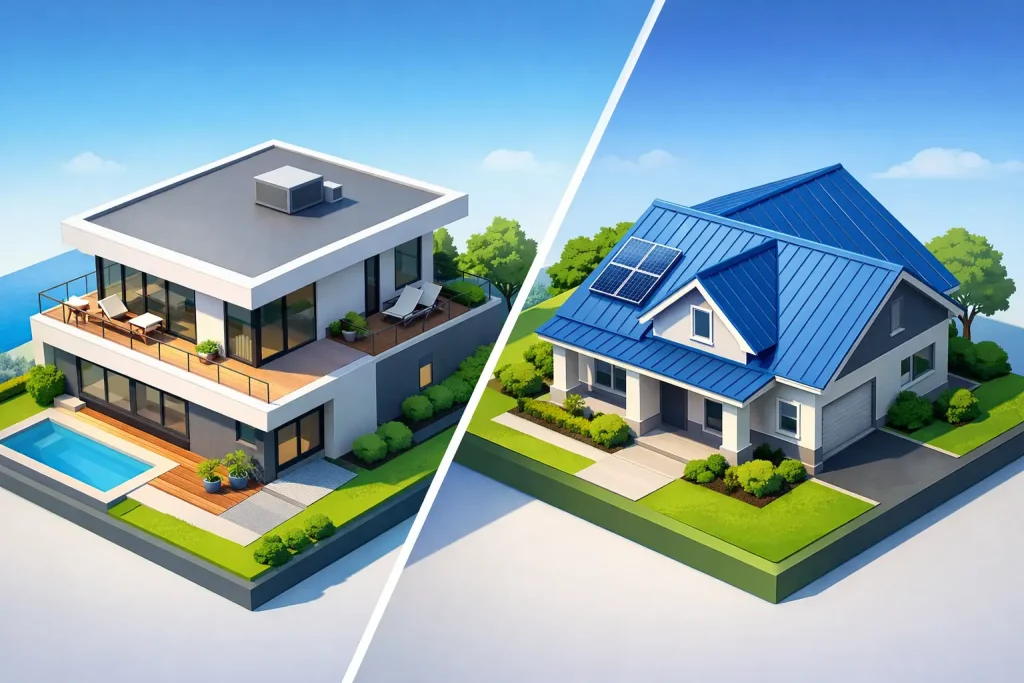
If you are weighing a flat roof vs metal roof decision, the right answer usually comes down to one thing – what kind of property you own and how much future maintenance you want to carry. On the Mississippi Gulf Coast, that choice also has to stand up to heat, wind-driven rain, humidity, salt air, and storm season. A roof that looks good on paper can turn into a headache fast if it does not match the building.
Some property owners come in focused on upfront price. Others care more about lifespan, insurance, leak resistance, or energy savings. All of that matters. But the best roofing choice is not the one with the loudest sales pitch. It is the one that fits your structure, your budget, and the way you plan to maintain the property over time.
Flat roof vs metal roof for different buildings
Flat roofing and metal roofing solve different problems. That is why this comparison is not as simple as saying one is better than the other.
A flat roof is common on commercial buildings, apartment complexes, schools, retail centers, and some modern-style homes. It gives you a low-profile look, easier access for HVAC equipment, and practical use on larger structures. It can also be restored with coatings in many cases, which matters when you are trying to control costs without rushing into a full tear-off.
A metal roof is more common on homes, churches, agricultural buildings, and light commercial properties with sloped framing. It sheds water fast, handles long service life well, and offers strong performance in tough weather when installed correctly. For many homeowners, metal is appealing because it combines durability with lower maintenance than many traditional systems.
So when customers ask about flat roof vs metal roof, the first question is not which one lasts longer. The first question is whether your building is designed for one, the other, or both.
Cost is more than the estimate
Upfront cost matters, especially when you are dealing with storm damage, leaks, or a roof that failed sooner than expected. But roofing decisions made on price alone often cost more later.
Flat roofing is often less expensive at the start on buildings designed for it. Installation can be efficient, especially on large commercial surfaces. If the roof is a candidate for restoration, coatings and waterproofing systems may extend service life without the expense of a full replacement. That can be a smart move for owners trying to protect cash flow.
Metal roofing usually carries a higher upfront price than many flat roof systems, especially on residential properties. The material cost is higher, and installation takes skill. But that higher entry cost can be offset by long lifespan, fewer replacement cycles, and lower ongoing repair needs.
For commercial owners, the math can go either way. A properly maintained flat roof with a quality coating system may give strong value over time. A metal retrofit system may make more sense when drainage is poor, chronic leaks keep returning, or the building needs a more durable long-term solution.
Performance in Gulf Coast weather
This is where the flat roof vs metal roof conversation gets serious.
South Mississippi weather is hard on roofing systems. Heavy rain can expose weak seams and drainage issues. High heat can wear down aging materials. Tropical weather tests fastening, flashing, and waterproofing. Salt air near the coast can also shorten the life of systems that are poorly selected or poorly maintained.
Metal roofs do well because they move water off the roof quickly. On sloped structures, that is a major advantage. They also tend to hold up well under sun exposure and can perform strongly in high winds when installed to the right standard. That does not mean they are maintenance-free. Fasteners, flashing details, penetrations, and panel condition still need attention.
Flat roofs can also perform well in this climate, but they need the right system and the right maintenance plan. Drainage is critical. Ponding water is not something to ignore. Seams, penetrations, edge details, and coating condition all matter. When a flat roof leaks, the damage can spread farther than many owners realize before it becomes visible inside.
That is why commercial flat roofing and waterproofing work should never be treated like a basic patch job. If the system is failing, the fix has to address the source of the problem, not just the symptom.
Lifespan and maintenance expectations
If you want the shortest version, metal roofs often win on lifespan, while flat roofs often offer more flexible repair and restoration options.
A quality metal roof can last decades with proper installation and maintenance. That long service life is a big selling point for homeowners planning to stay put and commercial owners who want fewer replacement cycles. The trade-off is that repairs can become specialized depending on the panel type, fastener system, and age of the roof.
Flat roofs vary more by material and condition. Some systems age well with regular maintenance and coating renewal. Others start showing trouble sooner if drainage, foot traffic, or installation quality were poor from the beginning. The advantage is that many flat roofs can be serviced, restored, or recoated in phases. That gives building owners more options when budgets are tight.
For facility managers and property managers, this matters. A flat roof may require more frequent inspection, but it can also be a manageable asset if you stay ahead of the wear. A metal roof may ask for less regular attention, but when issues do appear, you want an experienced contractor handling the repair details.
Appearance, energy use, and property goals
Homeowners often care about curb appeal. Commercial owners usually care more about protection, budget, and operational impact. Still, appearance and energy performance should not be ignored.
Metal roofing offers a cleaner visual finish for many homes and visible-slope buildings. It can give a property a more updated look and may support better reflective performance depending on the product and color selected. That can help with heat gain in hot months.
Flat roofing is usually not about curb appeal from the street. It is about function. But that does not mean it lacks energy value. Reflective roof coatings on commercial flat roofs can help reduce heat absorption and improve efficiency. For older buildings in Biloxi and surrounding areas, that can make a noticeable difference in cooling demand while also adding a layer of waterproof protection.
If your main goal is clean appearance and long-term residential durability, metal often has the edge. If your priority is protecting a large low-slope commercial building with practical restoration options, flat roofing may be the better fit.
Flat roof vs metal roof: when each one makes sense
A flat roof makes sense when the building is already designed for low-slope roofing, rooftop equipment needs accessible space, or restoration and coating options could save major money compared to replacement. It is often the practical choice for commercial properties, multifamily buildings, and larger structures where function matters more than visibility.
A metal roof makes sense when the structure has slope, long-term durability is a priority, and the owner wants a system known for shedding water and standing up well in harsh weather. It is a strong option for many homes and selected commercial properties where lifecycle value matters more than the lowest initial estimate.
There are also cases where the answer is neither a simple flat roof nor a standard metal replacement. Some buildings need retrofit framing. Some need coatings over an aging low-slope system. Some need targeted waterproofing and repair before a full replacement makes financial sense. That is why a real inspection matters.
The best choice depends on the roof you have now
The biggest mistake property owners make is shopping for roofing like it is a shelf product. It is not. The right recommendation depends on the deck, the slope, the age of the system, the leak history, the building use, and the budget.
A homeowner with repeated storm-related shingle issues may be a great candidate for metal. A commercial owner with a worn but recoverable low-slope roof may get better value from restoration and coatings. A property manager dealing with recurring leaks around penetrations may need a waterproofing-focused solution before talking replacement at all.
That is where working with an experienced local contractor pays off. Expert Roofing handles both metal roofing and commercial flat roofing across South Mississippi, along with coatings, waterproofing, and repairs. That means the recommendation can be based on what solves the problem, not on forcing every property into the same system.
If you are deciding between a flat roof and a metal roof, get the roof inspected before you commit to a number. The smartest roofing investment is the one that keeps your building dry, your costs predictable, and your next storm from turning into an emergency.