
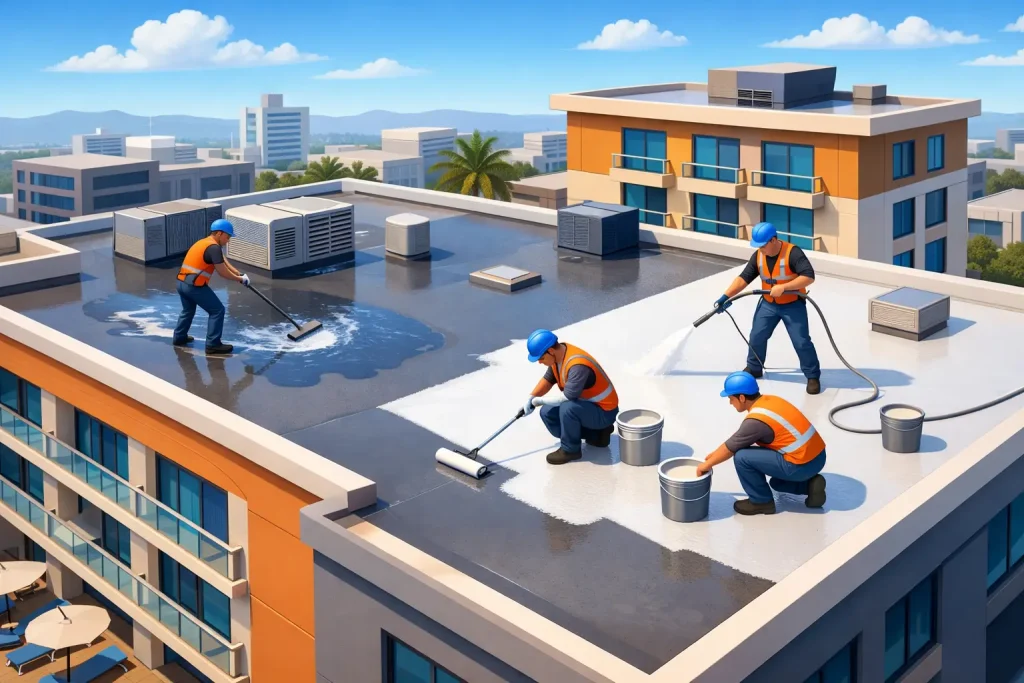
A hotel roof coating case study matters because a small roof leak can become a guest-room complaint, a ceiling repair, a mold concern, and a hit to the property’s reputation. For Gulf Coast hotel operators, the roof has to stand up to punishing sun, heavy rain, high humidity, and storm-driven wind. When an aging flat or low-slope roof starts failing, the question is not simply whether it leaks. The real question is whether a coating restoration can solve the problem without the cost, disruption, and downtime of a full tear-off.
This representative South Mississippi project shows how a hotel owner can evaluate that decision the right way. Every roof needs an in-person inspection before a contractor recommends a system, but the process below reflects the practical issues we see on leak-prone commercial roofs across the Coast.
The Problem: Leaks Above Occupied Hotel Space
The property had an aging low-slope roof over guest rooms and common areas. The roof was not at the end of its life everywhere, but it had reached the stage where routine patching was no longer providing confidence. Water was finding its way through weak seams, old penetrations, and areas where the existing surface had weathered under years of heat and standing water.
For a hotel, that creates a different level of urgency than it might for an unused warehouse. Maintenance staff cannot keep moving guests from room to room after every hard rain. Wet ceiling tiles, stained drywall, and damp insulation can spread the damage far beyond the original leak point. The owner needed a solution that would control water intrusion, protect the building, and keep work activity manageable around guests and staff.
A complete roof replacement was considered. It would have removed the existing roof down to the deck where needed and installed a new system. That is sometimes the right answer, especially when insulation is saturated, the deck is compromised, or the roof system has widespread failure. But a tear-off can be expensive, noisy, and more disruptive for an operating hotel.
The inspection showed that restoration was still a realistic option. Much of the roof assembly remained serviceable. The goal became repairing the roof correctly, then applying a high-performance coating system that would create a continuous waterproof membrane across the surface.
What the Roof Inspection Had to Confirm
Roof coatings are not a shortcut for a failed roof. They are a restoration system, and the existing roof has to qualify. A quality coating project starts with a close inspection, not a quick sales pitch.
The contractor evaluated the roof surface for open seams, splits, blisters, deteriorated flashings, loose materials, and weak areas around drains, vents, curbs, and HVAC equipment. Those details are where many commercial leaks begin. The roof was also checked for ponding water, because water that sits too long can shorten the life of any roofing system if drainage problems are ignored.
Moisture inside the assembly was another key concern. If insulation is saturated across broad areas, coating over the roof can trap a problem instead of solving one. In this case, damaged areas could be addressed locally while the larger roof field remained suitable for restoration.
That is the trade-off property owners need to understand. A coating can offer major savings and extend roof life, but only when the roof has enough sound material left to restore. If the system is structurally unsound or waterlogged throughout, replacement is the more responsible recommendation.
Hotel Roof Coating Case Study: The Restoration Plan
The restoration plan focused on fixing every known weakness before the coating was installed. The crew first cleaned the roof thoroughly to remove dirt, chalking, biological growth, and loose material. Coatings need a clean, dry, properly prepared surface to bond as designed. Skipping surface preparation is one of the fastest ways to turn a promising coating job into an early failure.
Next came the repair work. Open seams and cracks were sealed, damaged sections were repaired, and flashing details received special attention. Reinforcement fabric was used where movement or transitions called for extra strength. Roof penetrations, drain areas, and equipment curbs were treated as critical waterproofing zones rather than afterthoughts.
Once repairs were complete and the roof was ready, the coating system was applied in accordance with the manufacturer’s requirements. The result was a monolithic surface, meaning there were no exposed seams across the main roof field where water could work its way underneath. The finished coating also created a bright, reflective surface designed to reduce heat absorption.
For a hotel, that reflectivity can be a practical benefit. A cooler roof surface can reduce heat transfer into the building and lessen strain on air-conditioning equipment during long Mississippi summers. Actual energy savings depend on the building’s insulation, HVAC performance, roof color, occupancy, and many other factors, so no contractor should promise a fixed utility reduction without reviewing the property. Still, improving roof reflectivity is often a smart part of a larger energy-management plan.
Why Coating Was the Better Fit for This Property
The biggest advantage was avoiding a full tear-off while the existing roof still had usable life. Removing and replacing an entire commercial roof produces more labor, more material disposal, and more activity around the building. Restoration allowed the owner to address the waterproofing failures without paying for replacement work that the roof did not yet require.
The project also gave the hotel a more unified maintenance strategy. Instead of chasing isolated leaks after each storm, the owner had a repaired and reinforced roof surface designed to shed water as one system. That can make future inspections and maintenance more straightforward, especially when the same contractor documents the repairs and coating installation.
There was also an operational benefit. Roofing work always requires planning around safety and access, but coating restoration can often be less intrusive than a full replacement. Hotel management could coordinate work hours, protect guest areas below, and keep the property functioning with less noise and debris than a major tear-off would typically create.
Cost was a major factor, but it was not the only factor. The least expensive repair is not always the best value, and a coating should never be used to hide structural problems. In this case, the owner selected restoration because the inspection supported it, the repair scope was clear, and the lifecycle cost made sense for the property.
The Details That Protect the Investment
A roof coating is not a set-it-and-forget-it purchase. Like any commercial roofing system, it needs routine attention. Hotel maintenance teams should schedule inspections at least twice a year and after major storms. The goal is to catch punctures, drainage issues, storm debris, and damage from service work around rooftop equipment before they become interior leaks.
The roof should also be kept clear around drains and scuppers. Standing water is often a drainage problem first, and coating alone will not correct poor slope or blocked drainage paths. If rooftop HVAC contractors, cable installers, or other trades access the roof, their work should be monitored. A single careless puncture can compromise an otherwise excellent roofing system.
A good contractor will explain the warranty requirements before work begins. Many coating manufacturers require specific preparation methods, approved materials, and documented application thicknesses for warranty coverage. Property owners should ask direct questions about what is covered, how long coverage lasts, and what maintenance is required to keep it in force.
When a Hotel Should Choose Replacement Instead
Roof coating is a strong option, but it depends on the condition of the building. Full replacement may be the better path when there is widespread trapped moisture, severe insulation failure, structural deck damage, recurring movement-related splits, or a roof surface that cannot support proper adhesion.
Replacement can also make sense if the owner is planning major rooftop equipment changes, a renovation that affects the roof structure, or a long-term repositioning of the property. In those cases, installing a new commercial roof may provide the cleanest starting point.
The right contractor will not force one answer. They will inspect the roof, explain what they found in plain language, and give the owner a clear comparison between repair, coating restoration, and replacement. That is how hotel operators can make a decision based on condition and cost, not pressure.
For hotels across South Mississippi, fast action after the first signs of leaking can protect rooms, revenue, and guest confidence. Expert Roofing can inspect aging commercial roofs, identify whether coating restoration is a sound option, and provide a clear estimate for the work. A well-timed coating project may be the practical move that keeps a hotel dry, operating, and prepared for the next Gulf Coast storm.