
Hurricane‑Proof Shingles vs. Standard Shingles: Real-World Performance for Coastal Properties
Coastal roofs face wind, wind-driven rain, salt, and flying debris that expose ordinary shingles at eaves, ridges, and flashings—so the promise of hurricane-proof shingles is compelling but needs scrutiny. This article compares hurricane-proof shingles with standard asphalt shingles using lab standards, Miami-Dade and IBHS FORTIFIED criteria, and field evidence to show when upgraded products and correct system installation actually cut damage, repair costs, and downtime. You will get a concise procurement checklist, contractor questions, and a simple cost-versus-value framework to use in bids and insurance discussions.
How Coastal Storms Damage Shingles and Roof Systems
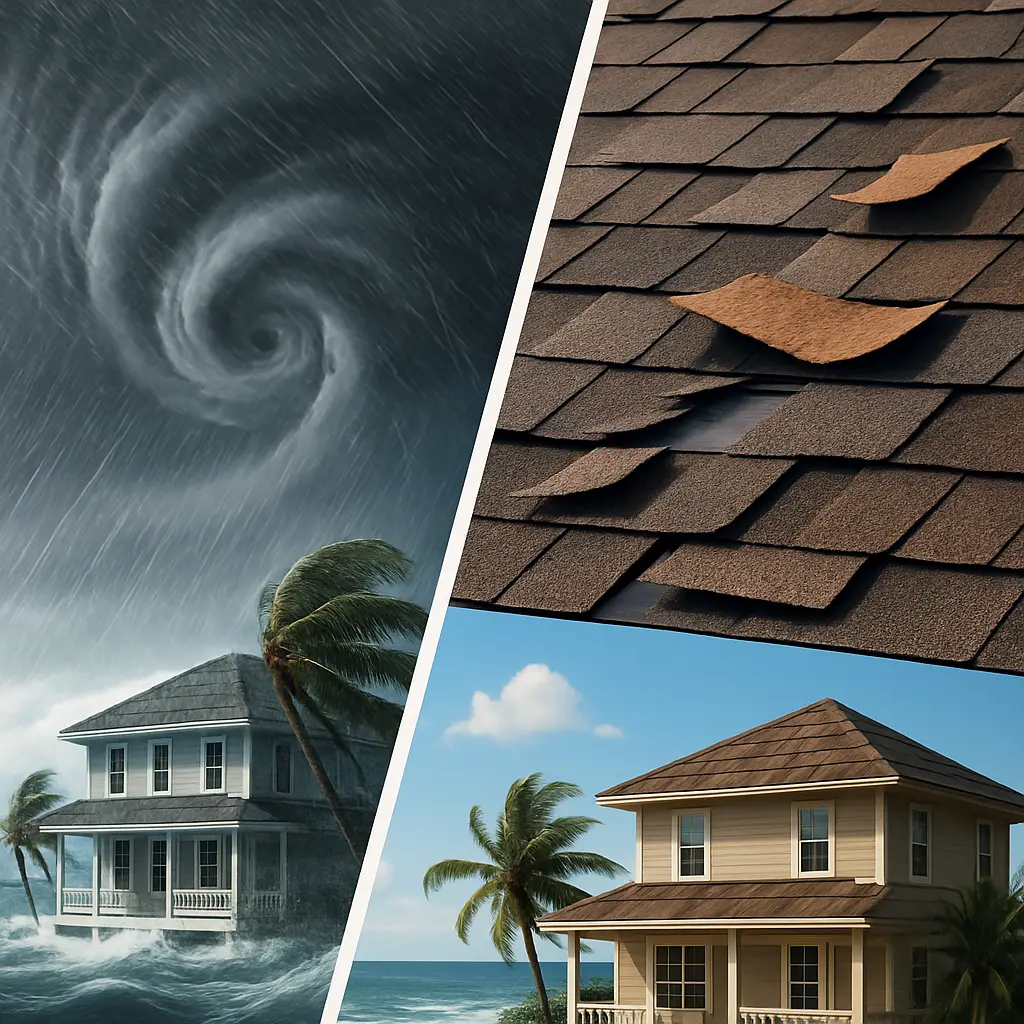
Primary claim: coastal storms damage roofs through three distinct mechanisms — wind uplift, wind-driven rain, and impact/debris — and each attacks different weak points in the system rather than the shingle surface alone. Typical sustained wind ranges by hurricane category give context: Category 1 = 74–95 mph, Category 3 = 111–129 mph, Category 4 = 130–156 mph; gusts at landfall commonly exceed those sustained speeds and drive failure beyond simple wind ratings (see FEMA building science guidance).
How the failures start and propagate
Wind uplift concentrates at edges. Eaves, rake edges, hips, and ridges experience the highest uplift forces; once the starter row or edge metal peels, the next few courses become vulnerable and failure cascades. Lab wind uplift numbers are useful, but in the field failures typically begin at the termination details and flashing interfaces.
Wind-driven rain exploits small breaches. Water intrusion is almost always a system failure — failed underlayment, missing secondary water barrier, or improperly lapped flashing — not just blown-off shingles. IBHS research and the FORTIFIED Roof criteria treat underlayment and flashings as equal partners to shingle selection (IBHS FORTIFIED Roof).
Salt and UV shorten useful life in ways manufacturers understate. Salt spray accelerates corrosion on metal flashings and fasteners and reduces adhesive bond life; prolonged UV and heat embrittle asphalt blends. The practical tradeoff: using polymer-modified or thicker shingles helps resist tearing, but without corrosion-resistant fasteners and robust flashings you pay more for product that will still fail at the edges.
Concrete example: On a Biloxi replacement job we saw intact architectural shingles still leaking because the starter course and edge metal were improperly fastened; replacing shingles alone did not stop leaks — we had to install self-adhering underlayment at the eaves and re-secure edge metal to meet system-level criteria. See a similar field project at Expert Roofing shingle rejuvenation.
- Post-storm inspection priorities: check for lifted starter strips and missing edge metal, look for gaps at step flashings and chimneys, inspect fasteners for corrosion or pull-through, and probe attic wet spots for delayed leaks.
- Material trade-off to weigh: higher wind-rated shingles cost more and often add weight; confirm roof framing capacity and fastening schedule before upgrading.
- Fastener decision: use stainless or hot-dipped galvanized nails and follow manufacturer spacing — cheaper fasteners are a false economy in salt-air zones.
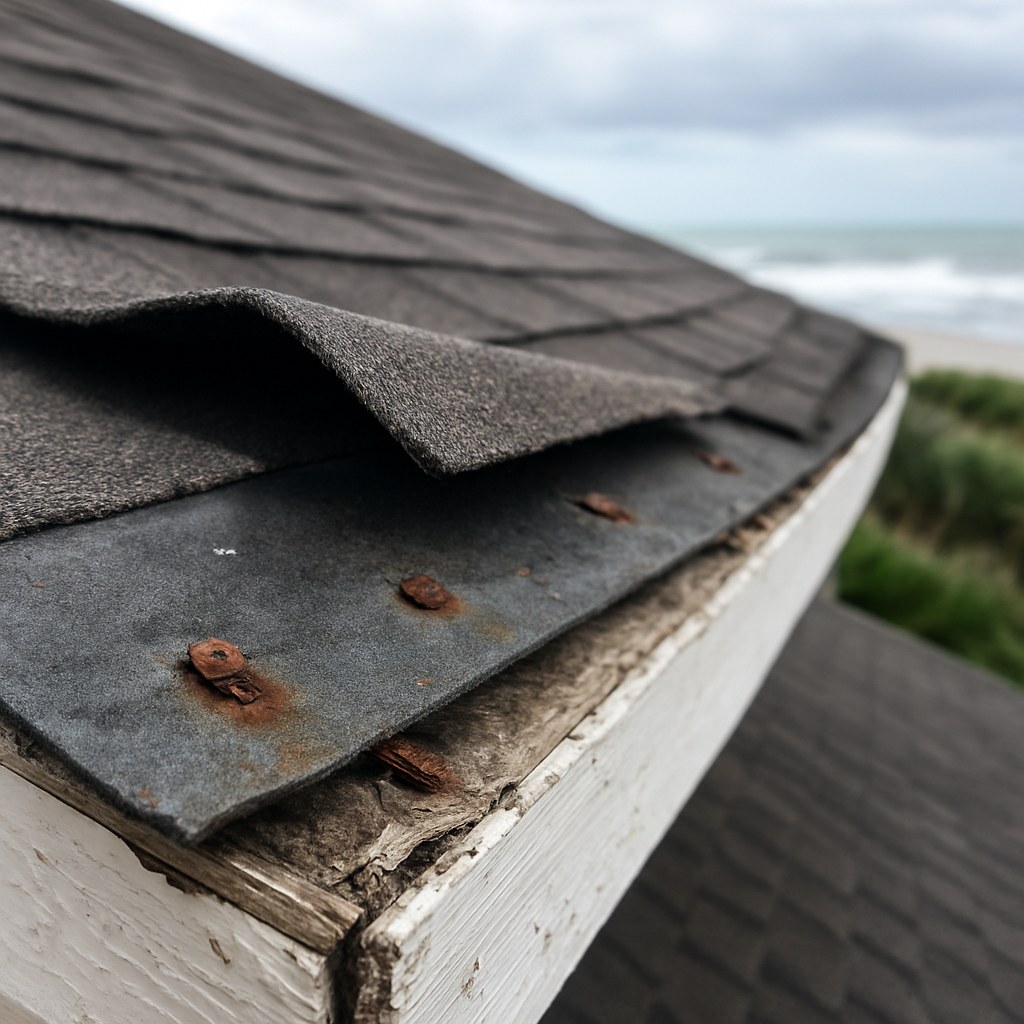
Next consideration: After a storm prioritize temporary water control and photographic documentation, then demand a system-level repair plan that covers starter course, underlayment, edge metal, flashings, and corrosion-resistant fasteners before approving a shingle-only replacement.
What Distinguishes Hurricane‑Proof Shingles from Standard Shingles
Key difference: hurricane-proof shingles are engineered as part of a tested roof system rather than as a standalone product. They combine modified materials, reinforced attachment features, and higher certified wind ratings so the shingle itself resists uplift and impact better than common three-tab or builder-grade shingles.
Measurable product differences
- Adhesive and sealant pattern: factory-applied, higher-tack sealants or wider adhesive bands improve shingle laminate retention in surge winds
- Mat and asphalt formulation: thicker fiberglass mats and polymer-modified asphalt improve tear resistance and temperature resilience in salt-air environments
- Reinforced nailing strip and defined fastener pattern: wider or reinforced nail zones and published nailing schedules reduce nail pull-through under uplift
- Impact and wind testing: products that target ASTM D7158, ASTM D3161, or Miami-Dade TAS approvals provide specific wind/impact numbers to check
- Accessory compatibility: hurricane-rated shingles assume specific starter courses, self-adhering underlayment at eaves, and edge metal details to meet system performance
Practical insight: a high wind rating on the shingle data sheet is useful, but it only tells half the story. The shingle may meet ASTM or Miami-Dade criteria in isolation, yet still fail in the field if the starter row, underlayment, flashings, or fastener pattern are wrong. Check the manufacturer installation bulletin and the product's Miami-Dade Notice of Acceptance where applicable.
| Feature | Hurricane-proof shingles | Standard shingles |
|---|---|---|
| Wind uplift resistance | Certified to ASTM D7158/D3161 or Miami-Dade TAS; published nail patterns | Limited or no wind certification; typical builder 60- or 110-mph warranties |
| Material build | Polymer-modified asphalt, thicker mat, reinforced nail zone | Basic asphalt coating on thin fiberglass or organic mat |
| System expectation | Requires specific starter, self-adhering underlayment, and edge metal | Often installed with minimal underlayment and generic starter strip |
| Warranty and insurer response | Longer wind warranties, potential FORTIFIED or insurance credits if installed per spec | Shorter warranties; fewer insurer incentives |
Concrete example: Expert Roofing replaced a Wiggins residential roof using Owens Corning Duration Storm with self-adhering eave underlayment and a 6-nail pattern at vulnerable perimeters. After a subsequent coastal storm the property required only localized flashing repairs while neighboring homes with standard three-tab shingles lost starter rows and experienced water intrusion. See our project context at Shingle Roof Rejuvenation In Wiggins MS | Expert Roofing Contractor | Biloxi MS | Roof Waterproofing | Coatings | Roof Repair.
Limitation and trade-off: hurricane-proof shingles cost more and can complicate installation on older decks. Thicker shingles change ridge and vent clearances, and some roofs need deck reinforcement to meet fastening torque and nail penetration requirements. Expect higher material and labor costs, and budget time for the additional accessory work the system requires.
Judgment you need to accept: product specs matter, but they are necessary not sufficient. If your contractor or specification omits the system accessories or uses a weak fastening pattern, the extra spend on hurricane-proof shingles delivers little in practice. Prioritize certified systems and proof of correct installation over a headline wind-rating alone.
Next consideration: when specifying, name the exact shingle model and the required accessory components, demand photographic installation records, and include acceptance of Miami-Dade or FORTIFIED criteria in the contract before assuming hurricane-proof performance.
Comparative Performance: Lab Ratings Versus Field Outcomes
Direct statement: Lab wind ratings matter, but they are not a substitute for system quality and installation. Measured uplift numbers are a starting point for specification, not a guarantee of roof survival in a real coastal storm.
Where lab metrics help and where they fail
Key limitation: Standards like ASTM D7158 and D3161 provide repeatable wind uplift stress tests, yet they evaluate shingles under controlled, short duration loading and typically on ideal substrates. That makes the ratings useful for comparing products, but they omit aging, salt corrosion, thermal cycling, attic pressure effects, accessory compatibility, and workmanship variability.
- What lab tests cover: peak wind uplift resistance, shingle adhesion strength, impact resistance under specified conditions
- What labs do not cover: installation quality, underlayment and flashing failures, wind-driven rain infiltration, cumulative UV and salt degradation, fastener corrosion and placement errors
- Why this matters: field failures often start at edges, flashings, and penetrations where system components or poor fastening create a weak link
Practical insight: Request system-level proofs such as a Miami-Dade Notice of Acceptance or IBHS FORTIFIED documentation rather than only a product wind table. Those programs reflect combined product and installation requirements and align better with insurance and permitting outcomes. See IBHS FORTIFIED guidance at IBHS FORTIFIED Roof and compare product standards at ASTM D7158.
Concrete example: A Gulf Coast multifamily replacement used a high-wind rated shingle but the contractor skipped the required starter strip and used fewer fasteners than the manufacturer specified. After a Category 1 storm several eaves lifted and water intrusion occurred despite intact shingle tabs. The same product installed per Miami-Dade acceptable details on a nearby building showed minimal damage in the same event.
| Lab metric | Field outcome and caveat |
|---|---|
| Published wind uplift speed (mph) | Useful for comparison – does not account for edge amplification, deck condition, or installation gaps |
| Impact resistance rating | Predicts hail or debris tolerance for the shingle itself but not for flashings or skylights |
| Accelerated aging tests | Simulate degradation trends but cannot reproduce decades of salt exposure and intermittent storm loading |
Judgment: For coastal properties the best risk reduction comes from pairing higher-rated shingles with rigorous system details and contractor accountability. Prioritize Miami-Dade or FORTIFIED system acceptance, documented fastening patterns, and corrosion-resistant accessories over chasing marginally higher mph numbers on a data sheet.
Next consideration: When you request bids, ask for both the shingle certification and the installer proof points – a Notice of Acceptance, a signed fastening checklist, and photos of starter and underlayment. Those three items convert lab promise into field value.
Installation and System Components That Make or Break Performance
Fact: hurricane-proof shingles only deliver their rated protection when they are integrated into a correctly installed roof system. Product specs matter, but the difference between a roof that survives and one that fails is almost always installation and accessory compatibility – starter courses, underlayment, edge metal, fasteners, and flashing.
Critical details installers must get right
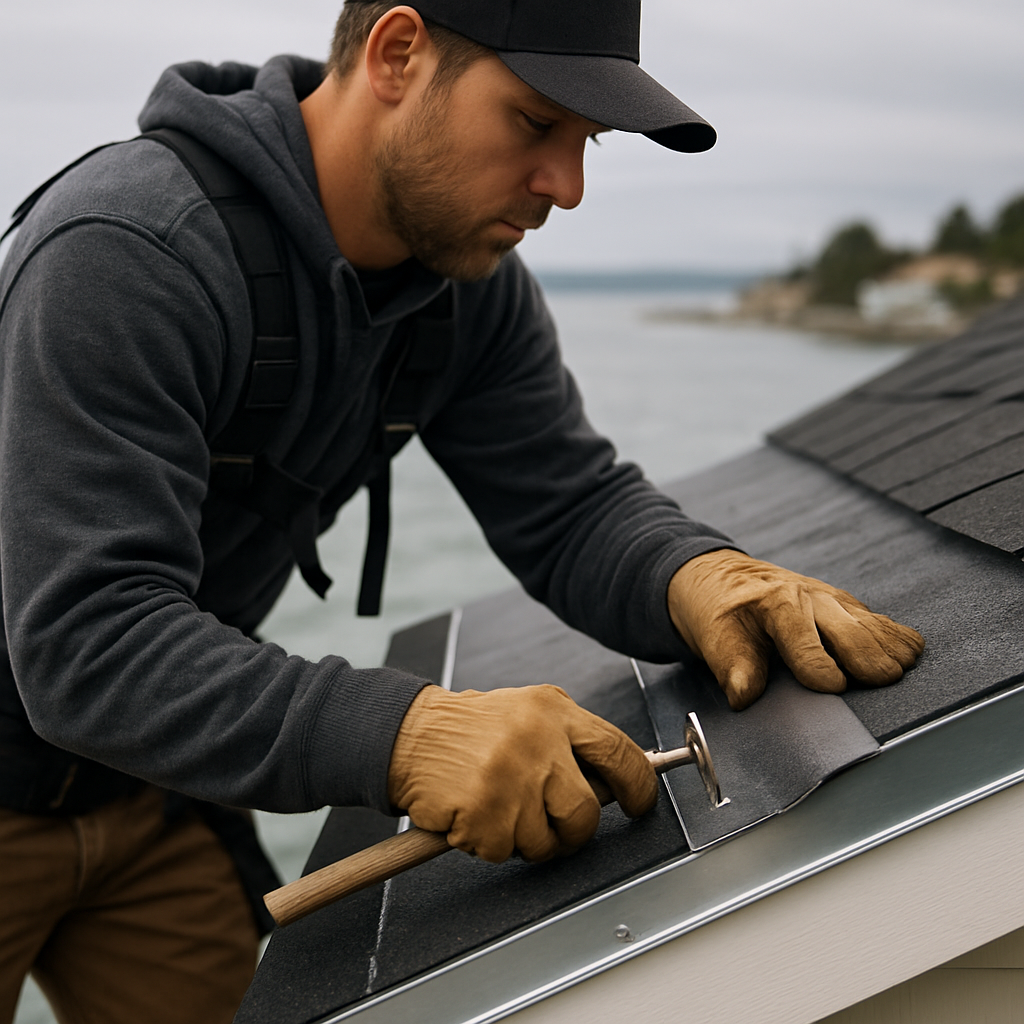
- Starter strip and adhesive: a certified starter course with continuous sealant at the eaves and rakes prevents peel-up at the first lift of wind. Builders who skip a starter strip or use generic adhesive lose the shingle wind warranty.
- Underlayment and secondary barrier: use a self-adhering underlayment at eaves and a high-performance synthetic underlayment across the field to resist wind-driven rain. Underlayment is the last line before interior damage.
- Fasteners and nailing pattern: follow the manufacturer pattern exactly. Common practice for high-wind installations increases nail count and requires specific placement inside the nailing strip – substituting staples or using undersized nails is a frequent failure mode.
- Edge metal, drip, and fascia attachment: mechanically secure edge metal to structural framing where possible. Loose edge metal allows wind to lift shingles at the vulnerable eave/rake transition.
- Flashings and penetrations: properly through-wall flashings, counterflashing, and sealed pipe boots stop water entry even when shingles lift. Flashing workmanship beats higher wind ratings every time.
Trade-off to consider: using heavy self-adhering underlayment and extra fasteners raises material and labor cost by 10 to 25 percent, but it materially lowers the probability of water intrusion and emergency repairs after a storm. Expect higher upfront cost, but reduced downtime and claims in real deployments.
| Common installation element | Typical standard practice | Hurricane-rated practice (example) |
|---|---|---|
| Nails per shingle | 4 nails or staples | 4 to 6 nails, specific placement inside nailing strip |
| Eave protection | Felt underlayment | Self-adhering membrane at eaves and rakes |
| Starter course | Optional or generic | Manufacturer-approved starter with continuous sealant |
Concrete Example: On a Wiggins MS replacement project we removed two shingle layers, installed a continuous self-adhering underlayment at eaves, used a certified starter course, and followed the 6-nail pattern specified by the shingle manufacturer at hips and ridges. After a tropical storm the building had patch-level damage only; neighbouring properties with standard installs required full reseals and emergency tarps. See our project notes on shingle rejuvenation for context at Shingle Roof Rejuvenation In Wiggins MS.
If the contract does not require photographic proof of starter strips, underlayment laps, and fastener pattern, assume the installation will be shortcut.
Real-World Case Studies and Field Examples
Key observation: product certification matters, but workmanship and documentation decide who gets paid after a storm. In field work on the Gulf Coast we repeatedly see roofs with hurricane-rated shingles fail because the starter row, fastener pattern, or underlayment details were missed — and insurers treat that as an installation issue, not a product failure.
Expert Roofing — Biloxi residential replacement
Concrete example: Expert Roofing replaced a 20-year-old asphalt roof in Biloxi with a high-wind architectural shingle, upgraded to a self-adhering underlayment at eaves, added a reinforced starter strip, and installed the contractor-specified fastening pattern with ring-shank nails. After a subsequent tropical storm the owner reported no leaks and minimal edge lift; neighboring houses with standard three-tab shingles experienced multiple edge failures and interior water intrusion. Photographic installation records and manufacturer product sheets were required for the insurance claim adjustment.
IBHS/FEMA documented comparisons
Field takeaway: studies by IBHS and FEMA show system-level upgrades reduce functional failures and recovery time even when shingles are similar on paper. See the IBHS FORTIFIED program for program criteria and case studies: IBHS FORTIFIED Roof program overview and guidance. In practice, IBHS cases demonstrate fewer roof-related business interruptions when secondary water barriers and improved edge details are present.
| Location / Project | System installed | Observed outcome after storm | Practical takeaway |
|---|---|---|---|
| Biloxi residential (Expert Roofing) | High-wind architectural shingle, self-adhering underlayment, reinforced starter | No leaks; minimal edge-lift; insurer accepted claim with documentation | Installer documentation and correct accessories enabled warranty and insurance coverage |
| IBHS field study example | FORTIFIED or system-upgraded roofs | Fewer functional failures and faster recovery times | System upgrades matter more than single component ratings |
| Miami-Dade municipal retrofit | Miami-Dade approved shingles + strict fastening and inspection | Reduced post-storm repair backlog and faster permit closeouts | Local approvals speed recovery and influence insurer handling |
- Practical insight: Insurer acceptance often hinges on photographic proof of installation sequence — require it during procurement.
- Limitation: A hurricane-rated shingle cannot compensate for poor flashing or corroded fasteners in salt-air environments; durable materials and maintenance matter.
- Trade-off: Higher-spec systems increase labor time by 20–40% on average because of dense nailing patterns and accessory installs — budget project schedule accordingly.
Inspection note: During post-install inspections look for continuous starter strip adhesion at eaves, correct nail placement through the reinforced nailing zone, and intact self-adhering underlayment at vulnerable transitions.
Judgment: If your goal is reduced downtime and fewer post-storm repairs, prioritize a verified system (shingles, underlayment, starter, edge metal) and a contractor who documents installation. Picking a hurricane-proof shingle alone buys potential performance on paper; getting that performance in the field requires tighter specs, supervision, and proof.
Cost, Insurance, and Lifecycle Value
Upfront premium is real and measurable. Expect hurricane-proof shingles and the system work that accompanies them to cost roughly 10 to 40 percent more than standard builder-grade three-tab installations depending on house complexity and whether you add self-adhering underlayment, reinforced flashing, and upgraded edge metal.
Tradeoff to evaluate. The extra cost buys higher wind uplift ratings, better adhesive/sealant, and a system that is more likely to survive initial wind damage. The tradeoff is that lab-rated shingles only deliver value when the installation and accessory components are done to the same standard.
Simple payback framework
How to do the math. Calculate incremental cost, add expected maintenance delta, then subtract annual insurance savings and expected avoided storm repair costs to get a net present value over the planning horizon (10 to 25 years). Request insurer confirmation of any premium credits before signing a contract.
| Scenario | Incremental cost (example) | Annual insurance savings | Expected avoided storm repairs over 20 years | Net 20-year value |
|---|---|---|---|---|
| Conservative | $6,000 | $150 | $2,000 | -$2,700 |
| Aggressive | $8,500 | $500 | $12,000 | +$2,500 |
Concrete Example: A 2,000 square foot coastal home replaced an aging roof with a hurricane-rated shingle system including self-adhering underlayment and reinforced edge metal. The owner paid an incremental $7,200. The insurer agreed to a written $400 annual premium credit and claims after a category 2 event showed no shingle loss, avoiding an estimated $9,000 repair. Over 20 years the installation moved from payback negative to positive when avoided repairs and lower deductibles are included.
- Insurance caveat: Insurers vary; require written confirmation of premium credits, deductible reductions, or credits for IBHS FORTIFIED systems before relying on savings. See IBHS FORTIFIED Roof program.
- Warranty reality: Manufacturer wind warranties often require registered installation and specific fastener patterns to be valid. Demand both manufacturer and contractor workmanship warranties in writing.
- Lifecycle cost: Coastal exposure accelerates UV and salt degradation. Plan for more frequent inspections, targeted repairs, and consider coatings or shingle rejuvenation as documented at Shingle Roof Rejuvenation.
Bottom line: If your objective is minimizing downtime and recovery cost after storms, pay attention to system cost not just shingle price and get insurer commitments in writing. The math works for some properties and fails for others; make the decision on quantified incremental cost, verifiable insurance value, and local contractor competency.
Procurement and Specification Checklist for Coastal Properties
Immediate point: the specification and QA process determines whether hurricane-proof shingles perform like their data sheets or fail like ordinary shingles. Require system-level approvals and enforceable installation verification up front; otherwise you buy a better product and get the same leaks.
Minimum specification items (must-haves for coastal bids)
- Product approvals: demand Miami-Dade Notice of Acceptance or IBHS FORTIFIED acceptance where available and reference ASTM standards such as ___CODE0/CODE1___ in the spec. See IBHS FORTIFIED Roof for program requirements.
- Shingle selection: list acceptable models (example: Owens Corning Duration Storm, GAF high-wind options, CertainTeed Landmark Storm) but permit substitutions only with an equivalent NOA and manufacturer wind warranty endorsement.
- Fasteners and pattern: require corrosion-resistant ring-shank or mechanically equivalent fasteners (minimum 12-gauge or manufacturer equivalent) with embedment depth to penetrate deck by at least 3/4 inch; specify high-wind fastening pattern (typically 6-nail pattern where manufacturer requires it) and nail placement diagram in the contract.
- Underlayment and secondary barrier: self-adhering underlayment at eaves, valleys, and rake; full-field high-temp synthetic underlayment or manufacturer-approved secondary barrier for wind-driven rain.
- Starter, edge metal, and flashings: factory-recommended starter course with adhesive; continuous edge metal mechanically fastened to blocking; all flashings to be corrosion-resistant and sealed per detail drawings.
- Accessory compatibility: require that vents, pipe boots, hip/ridge systems, and drip edge are specifically approved by the shingle manufacturer; disallow generic accessories that void warranties.
Practical trade-off: specifying the absolute highest-standard materials raises bids 8–20% but reduces claim frequency and downtime. If your asset can tolerate short-term capital constraints, require full system specs; if not, narrow the spec to critical items (starter, underlayment, fastener pattern) and accept lesser accessories.
Contracting, verification, and warranty clauses to include
- Documentation deliverables: pre-installation photos of deck, voids or repairs, material delivery tickets, and progressive photos of starter row, underlayment laps, and a representative nail pattern (minimum 10 photos).
- Manufacturer endorsement: require written manufacturer wind-warranty endorsement that references the installed system, installer certification, and Miami-Dade NOA number where required.
- Workmanship warranty and holdback: minimum 5-year contractor workmanship warranty; retain 10% payment holdback for 45 days post-completion or until final joint inspection and warranty endorsement are issued.
- Inspection rights: right to bring manufacturer's technical rep for final inspection; require contractor to correct non-conforming work within 7 days at their cost.
- Insurance and permits: proof of general liability, workers compensation, and a copy of permit(s) noting approved roof system before work starts.
| Procurement need | Sample contract wording |
|---|---|
| Verify product approval | Contractor shall furnish Miami-Dade NOA or IBHS FORTIFIED certificate for each product prior to delivery. |
| Fastening verification | Contractor to provide installation checklist with nail type, spacing, and embedment photos as a condition of payment. |
| Warranty enforcement | Final payment withheld until manufacturer issues system wind-warranty endorsement and contractor provides signed workmanship bond (5 years minimum). |
Concrete example: for a 48-unit multifamily roof on the Mississippi coast we specified Miami-Dade NOA-listed shingles, self-adhering underlayment at eaves/valleys, and a 6-nail pattern in the seam area. The contractor produced a photo log and manufacturer inspection; after a near-miss tropical storm only minor ridge sealant work was needed while neighboring properties reported ripped starter rows and underlayment failures.
Next consideration: build a scored bid evaluation that weights NOA-confirmed products, installer manufacturer certification, and documented QA procedures higher than lowest price; require insurer sign-off on prospective credits before award.