
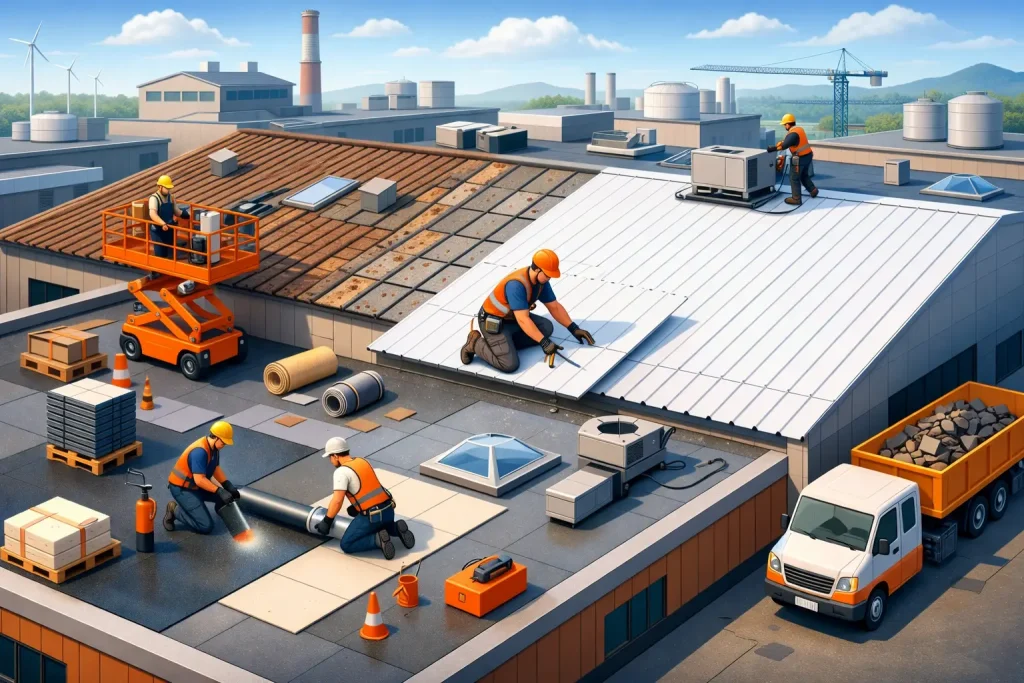
A leak over production space is not a small problem. It can slow crews down, damage inventory, create safety issues, and turn a manageable roofing issue into a costly interruption. That is why choosing the right industrial roof renovation contractor matters so much. You are not just hiring someone to patch a roof. You are hiring a company to protect operations, extend roof life where possible, and give you a clear plan that fits your building and your budget.
Industrial roofing decisions are rarely one-size-fits-all. Some roofs need targeted repairs and waterproofing. Some are strong candidates for coating-based restoration. Others are too far gone and need major renovation work or full replacement. The best contractor is the one who can tell the difference quickly, explain it plainly, and back the work with real experience.
What an industrial roof renovation contractor should actually do
A true industrial roof renovation contractor does more than show up with a crew and a proposal. The job starts with a real inspection. That means identifying active leaks, checking membrane condition, looking at seams and penetrations, evaluating drainage, spotting moisture intrusion, and reviewing any structural concerns that affect the roofing system.
From there, the contractor should help you sort out the right path. In many industrial settings, renovation does not automatically mean tear-off. If the roof deck is sound and the existing system still has serviceable life, restoration can be the smarter move. Coatings and waterproofing systems can seal problem areas, reduce heat gain, and delay replacement for years. On the other hand, if the roof has widespread saturation, failed insulation, or repeated repair history with no lasting result, a bigger rebuild may save money over time.
That is where experience counts. A contractor with broad commercial and industrial capability can look at the roof as a system, not just a leak source.
Renovation, restoration, or replacement?
This is where building owners and facility managers can lose money if they get rushed into the wrong recommendation. A low bid repair might only buy a few months. A full replacement might be sold when a restoration system would have solved the problem at a lower cost.
Renovation usually falls in the middle. It can include section replacement, substrate repairs, flashing upgrades, drainage corrections, coating application, waterproofing work, and reinforcement around rooftop equipment or high-failure areas. It is more substantial than routine maintenance but less extreme than tearing everything off and starting over.
Restoration is often the best fit when the existing roof is aging but still structurally workable. Coating systems are especially valuable on many low-slope and flat industrial roofs because they create a renewed weatherproof surface without the disruption of a full replacement. This can be a strong option for buildings that need to stay operational during the work.
Replacement makes sense when the roof has reached the end of its useful life, when trapped moisture is widespread, or when repeated patching has become a waste of money. A good contractor will tell you when restoration is no longer the honest answer.
Signs you need an industrial roof renovation contractor now
Some warning signs are obvious. Interior leaks, stained ceilings, mold concerns, and storm-related damage all call for immediate attention. Others are easier to ignore until the problem spreads.
If your industrial roof has standing water after rain, recurring seam failures, cracked flashing, bubbling surfaces, rising cooling costs, or repeated service calls for the same leak zones, it is time for a serious assessment. If your maintenance team is constantly chasing water around vents, curbs, skylights, or wall transitions, that usually points to a larger system issue.
Older industrial buildings across the Gulf Coast also deal with intense sun, humidity, heavy rain, and storm exposure. Those conditions speed up wear on flat and low-slope roofing systems. In South Mississippi, waterproofing and coating performance are not side issues. They are central to how long a roof lasts.
How to evaluate an industrial roof renovation contractor
Start with whether the contractor understands industrial work, not just general roofing. Industrial properties often have larger spans, more rooftop equipment, stricter access requirements, and more serious consequences when leaks disrupt operations. A contractor should be comfortable working around production schedules, tenant activity, loading areas, and safety protocols.
You also want a company that can explain multiple solutions. If every inspection ends in the same sales pitch, that is a red flag. The right contractor should be able to compare repair, renovation, restoration, coatings, and replacement based on your roof condition and your goals.
Ask direct questions. What is causing the leak pattern? How much of the roof is still salvageable? What is the expected service life of the recommended system? Will the work reduce energy costs? How much disruption should your team expect? If the answers are vague, move on.
Documentation matters too. A professional scope should outline problem areas, recommended repairs or systems, material details, warranty information, and any exclusions. Clear pricing matters, but clear scope matters just as much. A cheap number means very little if half the needed work is left out.
Why coatings are often part of the conversation
For many industrial buildings, coatings are not a shortcut. They are a practical renovation tool when used on the right roof. A quality coating system can help stop leaks, improve reflectivity, reduce thermal stress, and extend roof life without the cost and disruption of full replacement.
That said, coatings are not magic. They only work when the surface is prepared correctly and the underlying roof is a good candidate. If insulation is saturated or the substrate is failing, a coating alone will not fix the real problem. This is one of the biggest reasons to work with a contractor who has restoration and replacement experience. You need someone who knows when coatings make sense and when they do not.
For Gulf Coast properties, this matters even more. Heat, storms, and moisture put constant pressure on industrial roofing systems. A well-installed coating and waterproofing system can be a strong long-term value, but only if the prep work and detailing are done right.
What a good project process looks like
A reliable industrial roof renovation contractor keeps the process straightforward. First comes the inspection and condition review. Then you get a recommendation tied to actual roof conditions, not guesswork. After that, the contractor should walk you through scheduling, access, safety needs, material selection, and warranty coverage.
Communication during the job matters as much as the work itself. Industrial clients need updates that are clear and timely. If weather delays the project, you should know. If hidden damage is uncovered, you should see exactly what changed and why. If operations need to be protected in phases, the contractor should plan around that from the beginning.
This is where a local, service-driven company has an advantage. Fast response, practical problem-solving, and accountability matter when you are dealing with active leaks or weather threats. A contractor that can handle emergency tarping, repairs, coatings, waterproofing, and broader renovation work under one roof saves time and cuts down on confusion.
Cost matters, but so does the cost of waiting
Every industrial client wants a fair price, and they should. But the cheapest short-term answer is often the most expensive long-term choice. Delaying renovation can lead to wet insulation, interior damage, equipment risk, code issues, and production disruption that costs far more than the roof work itself.
The better question is not just what the project costs today. It is what value you get over the next five, ten, or fifteen years. Sometimes that means investing in a stronger system now. Sometimes it means using a renovation and coating strategy to stretch the life of an existing roof while planning for future replacement.
That is why free estimates and financing options matter for many property owners. They make it easier to act before the roof problem becomes a building problem.
Choosing the right industrial roof renovation contractor in South Mississippi
If you manage or own an industrial property in South Mississippi, look for a contractor that understands regional weather, low-slope roofing, waterproofing, and the realities of keeping facilities operational during roofing work. You want experience, clear answers, fair pricing, and a company that shows up when it says it will.
Expert Roofing is one example of the kind of contractor many industrial owners look for – local, experienced, equipped for both restoration and replacement, and focused on practical solutions instead of one-size-fits-all sales talk. That matters when your roof needs more than a patch but less than guesswork.
The right contractor will not push you toward the biggest job. They will push you toward the right one. If your roof is showing signs of failure, now is the time to get it inspected, get real options, and make a move before the next storm makes the decision for you.